


Elections & appointments
Explanatory note on procedures and voting
This is an explanatory guide, and reference should be made to the Rules of Procedure of the Codex Alimentarius Commission and the General Rules of FAO as contained in Volume I & II of the FAO Basic Texts.
Complete list of the Officers of the Commission and Members of the Executive Committee from 1963 to the present is available at the CCEXEC page.
Complete list of the Members of the Codex Alimentarius Commission as of 1 February 2017 is available at the Codex Members page.
Note: Regional coordinators became full members of the executive committee starting in 2005.
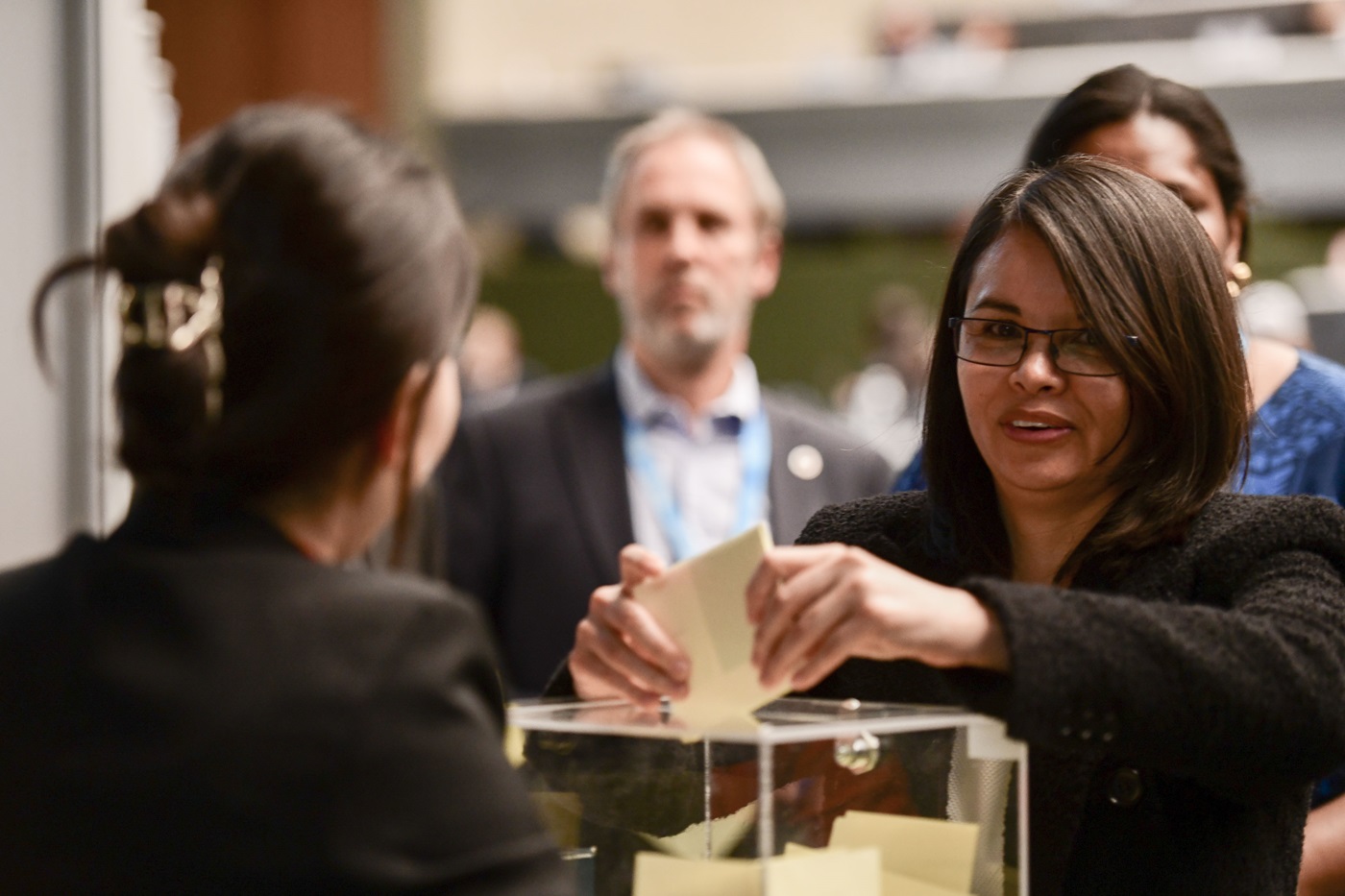
Election of the Chairperson and Vice-Chairpersons
Rule III.1
The Commission shall elect a Chairperson and three Vice-Chairpersons from among the representatives, alternates and advisers (hereinafter referred to as “delegates”) of the Members of the Commission; it being understood that no delegate shall be eligible without the concurrence of the head of his delegation. They shall be elected at each session and shall hold office from the end of the session at which they were elected until the end of the following regular session. The Chairperson and Vice-Chairpersons may remain in office only with the continuing endorsement of the respective Member of the Commission of which they were a delegate at the time of election. The Directors-General of FAO and WHO shall declare a position vacant when advised by the Member of the Commission that such endorsement has ceased. The Chairperson and Vice-Chairpersons shall be eligible for re-election twice, provided that by the end of their second term of office they have not served for a period of more than two years.
Each Member of the Commission has one vote:
Rule II.3
A Member Organization may exercise on matters within its competence, in any meetings of the Commission or any subsidiary body of the Commission in which it is entitled to participate in accordance with paragraph 2, a number of votes equal to the number of its Member States which are entitled to vote in such meetings and present at the time the vote is taken. Whenever a Member Organization exercises its right to vote, its Member States shall not exercise theirs, and conversely”.
Rule III.4
A Member Organization shall not be eligible for election or designation, nor to hold office in the Commission or any subsidiary body. A Member Organization shall not participate in voting for any elective places in the Commission and its subsidiary bodies. Members of the Commission are those Member Nations of FAO or WHO which have notified either the Director-General of FAO or of WHO of their wish to be Members of the Commission. In accordance with the Rules of Procedure, only participating Members of the Commission can nominate or vote during the Session.
Rule VIII.1
Subject to the provisions of paragraph 3 of this Rule, each Member of the Commission shall have one vote. An alternate or adviser shall not have the right to vote except where substituting for the representative.
Rule I.2
Membership shall comprise such eligible nations as have notified the Director-General of FAO or of WHO of their desire to be considered Members of the Commission.
The quorum for the conduct of elections in the Commission is the majority of the Members of the Commission attending the session, provided that such a majority is not less than 20% of the total membership of the Commission, nor less than 25 Members.
The relevant Rule of the Commission is as follows:
- Rule VI.7
The majority of the Members of the Commission shall constitute a quorum for the purposes of making recommendations for amendments to the Statutes of the Commission and of adopting amendments of, or additions to, the present Rules in accordance with Rule XV.1. For all other purposes the majority of the Members of the Commission attending the session shall constitute a quorum, provided that such a majority shall be not less than 20 percent of the total membership of the Commission, nor less than 25 Members. In addition, in the case of amendment or adoption of a proposed standard for a given region or group of countries, the quorum of the Commission shall include one third of the Members belonging to the region or group of countries concerned.
The General Rules of FAO provide for three types of vote: by show of hands, roll call or secret ballot.
According to Rule VIII.4 of the Commission, any Member of the Commission may request a roll-call vote, in which case the vote of each Member shall be recorded.
Votes by roll call are conducted under the provisions of Rule XII.7 of the General Rules of FAO.
(a) Subject to the provisions of paragraph 10 of this Rule, a vote by roll call shall be taken either upon request of a delegate or representative, or if a majority of two-thirds is required by the Constitution or these Rules. Voting by roll call shall be conducted by calling in English alphabetical order the names of all Member Nations entitled to vote. The name of the first nation to be called shall be designated by lot drawn by the Chairperson. The delegate or representative of each Member Nation shall reply "Yes", "No", or "Abstention". At the conclusion of any roll call, the name of any Member Nation whose delegate or representative failed to answer shall be called again. The vote of each Member Nation participating in any vote by roll call shall be inserted in the record of the meeting.
A vote on a decision can also be decided by secret ballot if the Commission so determines (Rule VIII.5 of the Commission refers, see below).
The Rules of Procedure of the Commission prescribe that elections shall be decided by secret ballot except where the number of candidates does not exceed the number of vacancies. In this latter case, the Commission may decide to proceed by means of clear general consent.
The relevant Rule of the Commission is as follows:
Rule VIII.5
Elections shall he decided by secret ballot, except that, where the number of candidates does not exceed the number of vacancies, the Chairperson may submit to the Commission that the election be decided by clear general consent. Any other matter shall be decided by secret ballot if the Commission so determines.
The election for the appointment of the Chairperson of the Commission is conducted under the provisions of Rule XII.11 of the General Rules of FAO, which reads as follows:
In any election for one elective place, other than that of the Director-General, if a candidate fails on the first ballot to obtain a majority of the votes cast, successive ballots shall be taken at such time or times as the Conference or Council shall decide, until a candidate obtains such a majority, provided that in an election for one elective place in which there are more than two candidates, the candidate having received the lowest number of votes at each ballot shall be eliminated.
In the case of the elections of the three Vice-Chairpersons of the Commission, Rule XII.12 of the General Rules of FAO applies, except with respect to the quorum provisions which are those contained in the Rules of Procedure of the Commission, as explained in paragraph 4 above.
The relevant Rule is as follows:
- Rule XII.12
In any election to fill simultaneously more than one elective place, the following shall apply:
(a) (i) In the Conference a majority of the Member Nations of the Organization and in the Council two-thirds of the Members of the Council shall constitute a quorum. (ii) More than one half of the number of Members casting valid votes shall constitute the required majority.
(b) Each elector, unless he wholly abstains, shall cast one vote for each elective place to be filled. Each vote shall be cast for a different candidate. Any ballot paper which is not in conformity with these requirements shall be declared defective.
(c) The candidates who receive the largest number of votes shall be declared elected in a number equal to the number of elective places to be filled, provided they have received the required majority defined in subparagraph (a)(ii) above.
(d) If only some of the elective places have been filled after the first ballot, a second ballot shall be cast to fill the remaining elective places, under the same conditions as the first ballot. This procedure shall continue until all the elective places have been filled.
(e) If, at any stage during the election, one or more vacant places cannot be filled because of an equal number of votes having been obtained by two or more candidates, a separate ballot shall be held among such candidates to determine which of them shall be elected, in accordance with the provisions of subparagraph (c) above. Such procedure will be repeated as necessary.
(f) If in any ballot no candidate receives the required majority, the candidate that receives the smallest number of votes in that ballot shall be eliminated.
Under the General Rules of FAO only affirmative or negative votes count as “votes cast” for calculating the majority required. Abstentions and defective ballots are not counted in the calculation of the majority.
Rule XII.4(a) of the General Rules of FAO applies and reads as follows:
- (a) For the purpose of the Constitution and these Rules the phrase “votes cast” shall mean affirmative and negative votes, and shall not include abstentions or defective ballots.
In the case of a secret ballot, a defective ballot paper is one:
- with votes for more candidates than vacancies;
- with votes for persons or places not validly nominated;
- in multiple elections, with less votes than places to be filled;
- with any notation or mark not necessary to indicate the vote.
However, subject to the above any ballot paper shall be considered valid if the intention of the voter is clear.
Rule XII.4 (c) of the General Rules of FAO applies and reads as follows:
- (i) Any ballot paper carrying votes for more candidates than there are vacancies to be filled, or carrying a vote for an individual, nation or locality not validly nominated, shall be considered defective.
- (ii) In the case of an election to fill simultaneously more than one elective place any ballot paper carrying votes for less candidates than there are vacancies to be filled shall also be considered defective.
- (iii) The ballot paper shall carry no other notation or mark than those required for the purpose of indicating the vote.
- (iv) Subject to (i), (ii) and (iii) above, a ballot paper shall be considered valid when there is no doubt as to the intention of the elector.
Appointment of tellers
Rule XII.10(c) of the General Rules of FAO applies and reads as follows:
- (i) For the purpose of a secret ballot the Chairman of the Conference or Council shall appoint two tellers from among the delegates or representatives, or their alternates. In the case of a secret ballot for an election, the tellers shall be delegates or representatives, or their alternates, who are not parties directly interested in the election;
- (ii) The duties of the tellers shall be to supervise the balloting procedure, count the ballot papers, decide on the validity of a ballot paper in any case of doubt, and certify the result of each ballot;
- (iii) The same tellers may be appointed for successive ballots or elections.
Ballot papers
Rule XII.10(d) of the General Rules of FAO applies and reads as follows:
- Ballot papers shall be duly initialled by an authorized officer of the secretariat of the Conference or Council. The elections officer shall be responsible for ensuring compliance with this requirement. For each ballot only one blank ballot paper shall be given to each delegation entitled to vote.
Voting booths
Rule XII.10(e) of the General Rules of FAO applies and reads as follows:
- For a vote by secret ballot, one or more voting booths shall be set up, supervised in such a manner as to ensure complete secrecy of the ballot.
Replacement of invalidated ballot papers
Rule XII.10(f) of the General Rules of FAO applies and reads as follows:
- Should any delegate invalidate his ballot paper, he may, before leaving the precinct of the polling booths, request a new blank ballot paper, which shall be delivered to him by the elections officer on the surrender of the invalidated ballot paper. The invalidated ballot paper shall remain in the custody of the elections officer.
Attendance at counting of votes
Rule XII.10(g) of the General Rules of FAO applies and reads as follows:
- Should the tellers withdraw from the presence of the delegates or representatives in order to carry out the count of the votes, only the candidates or scrutineers appointed by the candidates may attend the count, but they shall not take part in the count.
Protection of secrecy of ballot
Rule XII.10(h) of the General Rules of FAO applies and reads as follows:
- Members of delegations and of the secretariat of the Conference or Council who are responsible for the supervision of any vote by secret ballot shall not disclose to any unauthorized person any information which might tend, or be presumed to tend, toward destroying the secrecy of the ballot.
Custody of ballot papers
Rule XII.10(i) of the General Rules of FAO applies and reads as follows:
- The Director-General shall be responsible for the safe custody of all ballot papers until the elected candidates take of office or for three months after the date of the ballot, whichever is the longer period.
Postponement of balloting in an election
In an election the Conference may postpone second or subsequent ballots.
Rule XII.13(b) of the General Rules of FAO applies and reads as follows:
- At any stage in an election after the first ballot has been held, further balloting may be postponed by the Chairperson with the concurrence of the Conference or Council.
A vote may be interrupted only on a point of order which is in connection with the voting. Rule XII.14 of the General Rules of FAO applies and reads as follows:
- Once voting has commenced, no delegate or representative may interrupt the voting except to rise to a point of order in connection with the voting.
Procedure and time limit for challenging the results of a vote or election are set out in Rule XII.15 of the General Rules of FAO, which read as follows:
- Any delegate or representative may challenge the result of a vote or election.
- In the case of a vote by show of hands or roll call vote, should the result be challenged, the Chairperson shall cause a second vote to be taken forthwith.
- A vote by show of hands or by roll call may be challenged only immediately after the result has been announced.
- A secret ballot may be challenged at any time within three months of the date upon which it took place or until the elected candidate takes office, whichever is the longer period.
- Should a vote or election by secret ballot be challenged, the Director-General shall cause the ballot papers and all relevant record sheets to be re-examined and shall circulate the result of the investigation, together with the original complaint, to all Member Nations of the Organization or of the Council, as appropriate.
Election of the Executive Committee Members on a geographical basis
The Codex Alimentarius Commission provisions for the elections of the Vice-Chairpersons shall apply mutatis mutandis to the election of the Members of the Executive Committee.
- See Rule V of the Rules of Procedure of the Codex Alimentarius Commission in particular V.2 and V.3
- V.2: The Executive Committee shall, between sessions of the Commission, act on behalf of the Commission as its executive organ. In particular, the Executive Committee may make proposals to the Commission regarding general orientation, strategic planning, and programming of the work of the Commission, study special problems and shall assist in the management of the Commission’s programme of standards development, namely by conducting a critical review of proposals to undertake work and monitoring the progress of standards development.
- V.3: The Executive Committee shall consider specific matters referred to it by the Directors-General of FAO and WHO as well as the estimate of expenditure for the Commission’s proposed programme of work as described in Rule XIII.1..
In addition Rule V.1 of the Rules of Procedure gives the relevant period that members can hold office as follows:
"Members elected on a geographic basis shall hold office from the end of the session of the Commission at which they were elected until the end of the second succeeding regular session and shall be eligible for re-election if they have not served for more than two years in their current term, but after having served two consecutive terms shall be ineligible to hold such office for the next succeeding term. Members elected on a geographic basis are expected to act within the Executive Committee in the interest of the Commission as a whole."
Appointment of the Regional Coordinators
Rule IV of the Rules of Procedure of the Codex Alimentarius Commission provides the procedures for the appointment of Regional Coordinators. The relevant Rule of the Commission is as follows:
Rule IV
- The Commission may appoint a Coordinator from among the Members of the Commission for any of the geographic locations enumerated in Rule V.1 (hereinafter referred to as “regions”) or for any group of countries specifically enumerated by the Commission (hereinafter referred to as ‘groups of countries’), whenever it may find, on the basis of a proposal of a majority of the Members of the Commission which constitute the region or group, that work for the Codex Alimentarius in the countries concerned so requires.
- Appointment of Coordinators shall be made exclusively on the proposal of a majority of the Members of the Commission which constitute the region or group of countries concerned. In principle, they shall be nominated at each session of the relevant Coordinating Committee established under Rule XI.1(b)(ii), and appointed at the following regular session of the Commission. They shall hold office from the end of this session. Coordinators may be reappointed for a second term. The Commission shall make such arrangements as may be necessary in order to ensure continuity in the functions of the Coordinators.
ORDER OF ELECTIONS
The elections are held in a clear order to implement the part of rule V.1 which states:
Not more than one delegate from any one country shall be a member of the Executive Committee.
“- Chairperson