Information for delegates
From the very beginning, the Codex Alimentarius has been science-based. Experts and specialists in a wide range of disciplines have contributed to every aspect of the Codex Alimentarius to ensure that its standards withstand the most rigorous scientific scrutiny.
All Codex Members and Observers are encouraged to participate in the process of developing Codex texts, through joining working groups, sending written comments and attendance at meetings. However, Codex sessions are complex events and require good preparation to ensure smooth operation and timely decision making.
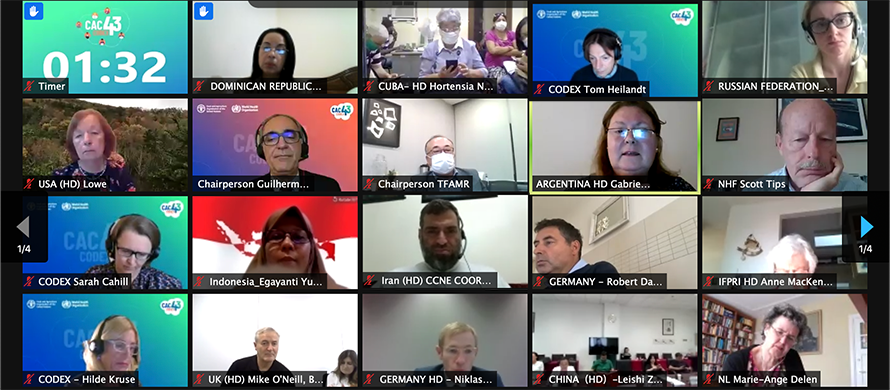
In 2020, due to the COVID-19 pandemic, meetings were held virtually for the first time, bringing a new dimension to participation.
This information aims to assist those who are attending a Codex meeting for the first time, who are attending a virtual Codex meeting for the first time, or who just need a refresher on participation in Codex meetings.
A well-prepared delegate will know:
- The essentials of the Codex Rules of Procedure, especially the 8-Step elaboration procedure (available online in the Codex Alimentarius Commission Procedural Manual);
- How to obtain the necessary documentation for a meeting which could include material from previous sessions or other related committees;
- The format of the meeting;
- How to make interventions during the meeting;
- The procedure for reviewing and adopting the report.
The sections below outline some key areas and have been updated to include changes introduced for virtual meetings. Additional guidance to participants of virtual meetings are also available:
Delegations should obtain all documentation from the Codex website well in advance of a meeting in order to familiarize themselves with the topics under discussion. The only documents printed at physical meetings are CRDs (conference room documents).
Each meeting page provides links to the relevant documents including, the provisional agenda, working papers, information documents and CRDs as they become available. The draft meeting report is also published on the page before report adoption and after meetings. The final report is published within two weeks of the conclusion of the meeting.
Invitation
The invitation, which is sent to all Codex contact points (CCPs) via the Codex distribution list contains information such as the date, time and venue of the meeting. Personalized invitations are not usually issued. Delegates should register through their Codex contact point as early as possible and, in any case, not less than 30 days before the opening of the meeting. Registration is usually through the online registration system (ORS) which requires a login to the Codex website.
Registration for a virtual meeting may also require additional steps. Follow the instructions on the specific meeting page.
Visa requirements (for physical meetings)
It is the responsibility of participants to ensure that they have the proper documentation for travel, including visas. Therefore, where required, participants must apply for entry visas as early as possible. The Codex contact points in host countries can provide the location of embassies or consulates but cannot expedite visa applications. The host secretariat and Codex Secretariat can only facilitate the visa process by providing a standard letter to registered delegates. If you require such a letter for your visa application, please select Visa Application Support when registering on the ORS.
Provisional agenda
The provisional agenda for the Codex Alimentarius Commission Executive Committee (CCEXEC) and for the Codex Alimentarius Commission (CAC) is prepared by the Codex Secretariat on behalf of the Directors-General of FAO and WHO in consultation with the CAC chairperson.
The agenda for committee meetings of subsidiary bodies is prepared and distributed by the Codex Secretariat in consultation with the chairperson and host country for that committee.
Working papers
Working papers form the basis for discussion during meetings. They are prepared in conjunction with the Codex Secretariat and are normally published on the Codex website where possible at least two months prior to a session in all the languages of the committee.
Conference room documents
Members and Observers are always encouraged to submit written comments on an agenda item by the deadline indicated in the Circular Letter (CL) issued specifically for this purpose.
Comments received after the due date for submission of comments, or unsolicited documents, are circulated the days immediately before and/or during the session itself and are referred to as conference room documents (CRDs).
They are usually in the original language only and may not be fully considered at the intended meeting due to other Members and Observers not having sufficient time or expertise in their delegation to consider the contents or to formulate a position without consultation.
Documents that should be reviewed or prepared prior to any Codex meeting include:
- Invitation, provisional agenda and other working documents;
- Previous report(s) of the committee and other related committees;
- Back-to-office report (personal report) of the head of delegation who attended the previous session. It is also highly recommended that delegates liaise with colleagues who may have attended previous meetings or related committee sessions;
- The Codex Alimentarius Commission Procedural Manual;
- A briefing for the head of delegation containing the position on relevant agenda items and related comments.
Opening of the session
Sessions are normally opened by a senior representative of the country hosting the committee, or of the parent organizations, FAO and WHO for CCEXEC and CAC sessions.
After the opening, the chairperson proceeds to the adoption of the agenda. Once comments on the provisional agenda have been considered, the chairperson will request that the committee adopt the provisional agenda or amended agenda as the agenda for the session.
Role of the chairperson
The chairperson ensures that all matters on the agenda are fully discussed, including the written comments of Members and Observers not present at the session. At appropriate intervals during the discussion of each agenda item, the chairperson will summarize the points raised and progress made. The chairperson ensures that the conclusions of the discussion are clearly presented to the plenary. The chairperson may request that the wording of a particular conclusion be shown on a screen to ensure clarity, especially for those following discussions in different languages.
How are decisions reached?
Each meeting will make every effort to reach agreement by consensus on the matters before. At committee level a chairperson may invite parties with divergent views on a matter to meet informally during the meeting in an attempt to resolve differences of opinion.
At CAC meetings, decisions to adopt or amend standards may also be taken by voting only if efforts to reach consensus have failed. Voting may also take place for the adoption of amendments to the Rules of Procedure (Learn more in the Codex Alimentarius Commission Procedural Manual Section I, Rule VIII Voting and Procedures).
Who is allowed to speak?
Members and Observers are permitted to intervene on issues under consideration. Normally the head of delegation takes the floor, but with the chairperson's permission, another member of the delegation may speak (e.g. on technical matters). Comments are always directed to the chairperson.
Protocol states that Members speak before Observers and delegations speak only when recognized by the chairperson
How do I indicate my delegations desire to speak?
Most physical meeting venues have an electronic queuing system for taking the floor, and for virtual meetings each platform usually has a “raise hand” function. Where there is no electronic queuing system, delegations should hold up their country or organization nameplate and place it in an upright position until acknowledged by the chairperson.
How many times may a Member intervene?
There are no uniform rules within Codex regarding the number and duration of interventions. The general practice is to intervene only once on a particular issue, although a second intervention may be allowed at the discretion of the chairperson, normally to clarify a point or reply to a question raised by another delegation.
It is important to keep interventions short and concise (not more than 1–2 minutes) and to speak clearly to allow for accurate simultaneous interpretation. Should a delegation read from written comments that appear in one of the working papers, it is essential to indicate the reference to the comments at the start of an intervention. At both physical and virtual meetings there may be a timer or “traffic lights” system in place to notify delegates that the allotted time for their intervention is ending.
A draft report of the meeting is prepared by the Codex Secretariat for consideration on the final day of the session during what is known as “report adoption”. The penultimate day of a physical meeting is usually set aside for final drafting and translation of this report (i.e. no plenary session is held). At physical meetings, the draft report is usually made available one hour before report adoption starts, to allow delegates to familiarize themselves with its contents. For virtual meetings, the chairperson will indicate when the draft report will be made available, mindful of the need for all delegations to be able to prepare for report adoption during working hours.
As the report is the official record of the meeting it is essential that delegations carefully read it to ensure that it accurately reflects the views, recommendations, and conclusions of the meeting. The final report aims to be concise, and views and opinions summarized are not usually associated with the names of specific delegations. Listen carefully at the opening of a meeting to understand how the chairperson intends to manage proceedings including the report adoption and matters such as reservations.
During the review or ‘reading’ of the draft report, the chairperson calls each paragraph or section by number. This allows delegations who wish to amend the text to intervene at the appropriate moment. When doing so, it is important to avoid lengthy preamble and make concrete proposals for changes (e.g. additions or deletions of specific text). At this stage, it is not possible to re-open discussions; nor is it possible to record in the report something that was not stated during the discussion.
The adoption of the report is integral part of the official agenda of the session, and all delegations are requested to take part. Once adopted, the report becomes the official record of the meeting and is then published in all the languages of the particular committee on the Codex website.