


“The fire must start within the countries” to see the impact of Codex standards
.jpg?sfvrsn=598a2f3c_0)
As part of a series of side events held at the 46th session of the Codex Alimentarius Commission in Rome, 1 December, five countries offered examples from their national experiences that demonstrate the impact of Codex standards. In introducing the event, FAO Food Safety Officer Catherine Bessy outlined the four strategic outcomes FAO is aiming for as part of efforts to develop capacity on food safety.
Madagascar, Kyrgyzstan, Saudi Arabia, Egypt and Uganda then all provided different perspectives and different examples of the use and implementation of standards in their countries.
Madagascar described their participation into the European Commission (EC)-funded Common Market for Eastern and Southern Africa (COMESA) Trade facilitation programme, with technical support from FAO, and in particular the component aiming at promoting the adoption of good practices on food import control, in reference to the FAO publication, the Risk-Based Imported Food Control Manual. Five Codex standards formed the basis for this work, including the guidelines on import control systems (CXG 47-2003), on official certificates (CXG 38-2001) and on rejections of imported goods (CXG 25-1997), as well as the guidelines and principles on the exchange of information to support the trade in food (CXG 89-2016) and on national food control systems (CXG 82-2013). The country has developed an action plan on the control and inspection of food imports, making use of training and inter-institutional cooperation.
Kyrgyzstan was one of the first countries to receive Codex Trust Fund (CTF) support and has used Codex standards as a basis for food safety legislation. Most notably, the Hazard Analysis and Critical Control Point (HACCP) system, which is an annex of the Codex General Principles of Food Hygiene (CXC 1-1969), has been incorporated into Kyrgyz law and the government offers relevant training to food business operators, leading to improved food quality and more successful food exports. Through the CTF project, the country developed 42 different national standards on food exports, which were harmonized with Codex within the project period. The General Standard for Contaminants and Toxins in Food and Feed (CXS 193-1995) and the General Standard for the Labelling of Food Additives when Sold as Such (CXS 107-1981) are also two key Codex texts that have had an important role to play in the adoption of standards in Kyrgyzstan.
Food additives were also key to Saudi Arabia’s success story, which started with a description of the Saudi Food and Drug Authority’s three-part strategy, which includes food safety, increased international and regional partnership and “excellence in operations”. Standards work in Saudi Arabia and the broader Gulf region has focused on a single document that aligns with Codex food additives texts and which has resulted in a positive impact on food safety and has facilitated trade. It has also led to the elimination of non-compliant products. Egypt told a very similar story in their adoption of the Codex General Standard for Food Additives (CXS 192-1995) (GSFA), which has contributed to a 14 percent increase in trade, which amounts to billions of dollars of additional profit. Egypt also focuses on the links that can be made between improved food standards implementation in the country, and the achievement of the Sustainable Development Goals. On the other hand, the adoption of the GSFA also means that any product containing additives not included in the standard are rejected for import or export.

We are making an impact for the future
For Uganda, a key focus in the use of Codex standards involves communication. If those at the sharp end of food handling and production, in markets and street food vending, for example, do not understand how to keep food safe, then the standards are not being effectively implemented. Posters and leaflets are produced in an easy-to-understand format that makes use of visuals and avoids jargon. A five-country CTF group project in East Africa is also focusing on improving communications about information included in the Code of Practice for the Prevention and Reduction of Mycotoxin Contamination in Cereals (CXC 51-2003) with a view to improving communication throughout the whole cereals chain.
In wrapping up, Bessy said: “The fire must start within the countries – and this is what we have seen today. The interest and dynamism” in implementing Codex standards ensures “we are making an impact for the future”.
Read more
FAO’s Risk-Based Imported Food Control Manual
Codex Alimentarius Commission 46th session information page
Related content
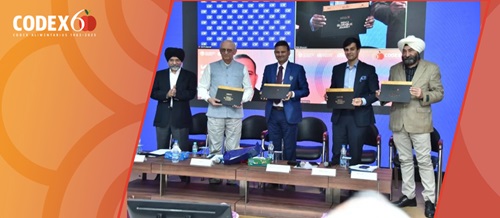
Codex@60 / A seminar and a coffee table book to celebrate India's journey in Codex
The Confederation of Indian Industry (CII) has teamed up with the Food Safety and Standards Authority of India (FSAII), to celebrate the 60th anniversary of the Codex Alimentarius Commission, with a seminar...

Codex podcast / Looking back, looking forward
This edition of the Codex podcast highlights the results of the 46th Session of the Codex Alimentarius Commission, which adopted 500 new and revised Codex standards - including numerical standards - guidelines...
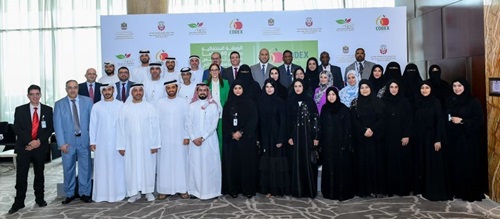
Celebrating the 60th anniversary of Codex in UAE
By Khadija Qalandari, Acting, Head of Technical Follow-up Standard Specifications Section, UAE The UAE National Codex Committee (NCC), led by the Abu Dhabi Agriculture and Food Safety Authority (ADAFSA),...
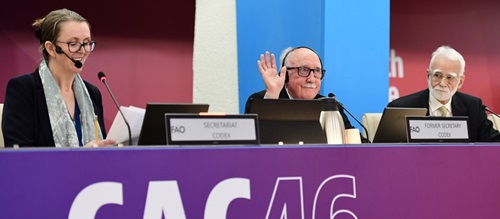
Codex@60 / Celebrating the international forum for food safety standards
Throughout this year, Codex Members and Observers have celebrated the 60th anniversary of the Codex Alimentarius Commission (CAC), which held its first meeting in June 1963. The celebrations began in...
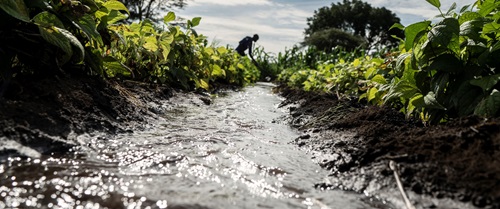
How new Codex guidelines will help food business operators address hazards in water
Earlier this month, the 46th Session of the Codex Alimentarius Commission agreed to adopt key new guidelines on the safe use and re-use of water in food production and processing. These guidelines provide...
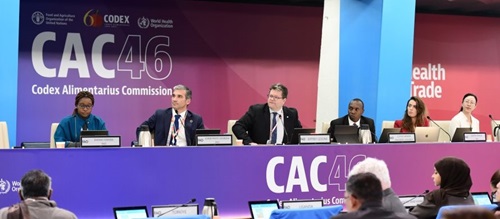
CAC46 / A side session on reducing foodborne antimicrobial resistance
Global experts convened to address the critical issue of reducing foodborne antimicrobial resistance (AMR) at the side event on 1 December 2023, as part of the 46th Session of the Codex Alimentarius Commission...
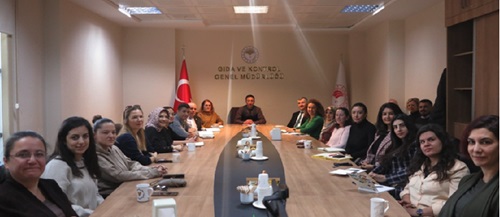
Türkiye celebrates 60 years of Codex
The Codex Contact Point (CCP) for Türkiye under the Ministry of Agriculture and Forestry planned several seminars and other initiatives to promote awareness on Codex in commemoration of the 60th anniversary...
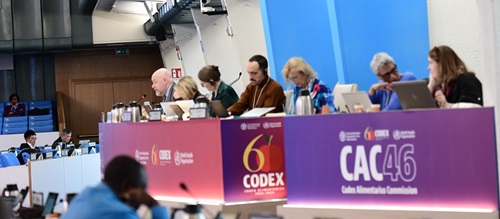
Codex adopts new food safety and quality standards at 46th Commission
For the first time after the Covid-19 pandemic, the Codex Alimentarius Commission (CAC) has concluded with a physical report adoption. This brings to a close a momentous meeting that opened with festivities...
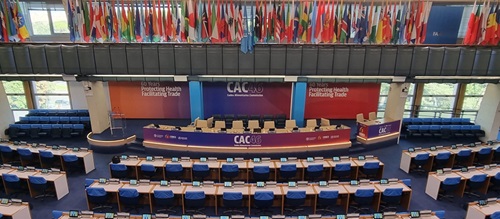
CAC46 / A time to celebrate – and to consider key new texts
The Codex Alimentarius Commission (CAC) meets this week, in Rome, for the 46th time – 60 years after its very first meeting in 1963. Codex Members and Observers will be celebrating this anniversary,...