


CAC48 / African parliamentarians are urged to advocate for Codex in a Commission side event
.jpg?sfvrsn=7c2b0df8_0)
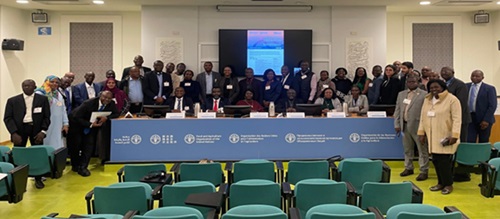
An event titled “Bridging the gap between the parliamentary community and Codex” was held in the margins of the 48th Codex Alimentarius Commission meeting Tuesday and brought together key Codex and FAO actors, and representatives from African parliamentary networks.
The event was held in a collaboration between Codex and the FAO partnerships and UN collaboration division and aimed to bring to the attention of parliamentarians the crucial role that effective participation in Codex can play in the health of consumers and in the international food trade. “Active participation in Codex means African voices shape Codex standards instead of simply adapting to them,” explained Sarah Cahill, Codex Secretary, “it means turning rejections into revenue, smallholders into exporters, and food safety challenges into competitive advantages. This is why raising awareness at parliamentary level is crucial. You, Honourable Members, can pass new legislation and regulations, allocate resources to national Codex committees and laboratories, and change the narrative.” In his introductory remarks explaining why FAO wanted to engage with parliamentary stakeholders, Jean-Léonard Touadi, who is a FAO Special Coordinator for Parliamentary Networks in the Partnerships Division, expressed a similar view, listing four facets of the role of parliamentarians: legislation; budgeting; oversight of public policies; and representation.
Discussants described the importance of the involvement of parliamentarians in Codex work from different perspectives, but returned often to these four points.
Hakim Mufumbiro, representing the outgoing coordinator for the FAOWHO Coordinating Committee for Africa (CCAFRICA), described what African nations and the African region have achieved in terms of not only developing regional Codex standards but also taking on leadership roles in Codex work. Countries of the region have benefitted from various types of training to build their Codex capacities and their national Codex structures. “But,” said Mufumbiro, “the experience we have is that there is cohesion at the technical level, but less so at the policy level.” There needs to be a greater awareness of the value of Codex work, and the political will to build capacity, participate and use Codex standards. “The issue of legislation seems to be often the missing piece in the puzzle,” concluded Mufumbiro.
John Oppong Otoo of the African Union’s Inter-African Bureau for Animal Resources (AU-IBAR) picked up that same point: “Many food safety laws need to be updated,” he said. “Not just updated but updated on Codex standards. This normalises and creates a level playing field for trade.” He made the point that “Africa is familiar with trade rejections” and this impacts on livelihoods. “It is why,” he said, “the African Union developed its food safety strategy.” The food safety strategy was also developed to protect consumer health. He pointed out the significant impact on Africans of the burden of foodborne illness in the region, citing the World Bank statistics: 91 million people in Africa fall ill each year as a result of unsafe food and this disproportionately affects children under five years of age. He also pointed out that developing countries lose USD 110 billion annually because of unsafe food. Speaking directly to the parliamentarians, Oppong Otoo stated: “You can advocate for more funding for food safety and for Codex work: there is under resourcing throughout the food supply chain. Coordination is lacking among competent authorities and parliamentarians play a crucial role in coordination.”
For Neema Lugangira, former Member of Parliament in Tanzania, Vice-Chair of the African Food Systems Parliamentary Network and Secretary General of Women Political Leaders (WPL), the global network of women politicians,these are also concerns: “Africa's agricultural potential is enormous,” she said, “yet, as many speakers have said, our food exports continue to face high rejection rates.” For this, she, too, returned to the issue of budget allocation for food safety, of “moving food safety to reality - in the labs, inspection and traceability”. She also wants to see more capacity building, so “producers, exporters, especially women, have the skills to take advantage of export markets.” But for Lugangira, it is food safety for Africans that is of most concern. “The challenge is to ensure food safety at home as well as the safety of food for trade. If we want to strengthen food safety it should not be once sided, it should be for internal as well export markets.”
The Honourable Adan Yusuf Hadji of the East Africa Parliamentary Alliance for Food Security and Nutrition (EAPA-FSN) made the point that “MPs are part of communities, they are normal people: you elect them and you should use them!” For him the salient issue with for parliamentarians in relation to Codex is harmonization. “By harmonizing, and fitting into international trade,” he said, for Africa, “that will reduce costs of production, lower trade barriers and lead to efficiency.”
Patrick Sekitoleko of the Codex Secretariat explained something of the work of the Codex Committee on Food Import and Export Inspection and Certification Systems that is linked both to national food control systems, and international food trade. FAO Senior Food Safety Officer, Catherine Bessy, also explained the work of FAO to provide a link between the texts developed by Codex and how countries put them into action.
Wrapping up the session, the Honourable Fatimetou Habib, First Vice-President of the Pan African Parliament thanked those who took part in the event and suggested Codex“work with us so we can look at the situation and have safe and nutritious food for African citizens.” Mamodou Bah, of the Gambia and representing the incoming CCAFRICA Coordinator, said “From the discussions, I can see there is a disconnect between the lawmakers and the food safety regulators. That is something we need to fix. As incoming Chairperson, we will connect and refuse to disconnect!” CAC Chairperson, Allan Azegele noted that “most parliamentarians are unfamiliar with Codex – across the world.” He noted that there is a need for political will, capacity training and greater awareness.
Read more
Photo © FAO/Roberto Sciotti
Related content
High-level advocacy event strengthens Africa’s commitment to food safety and Codex participation
by the CCP of The Gambia On the margins of the 49th Session of the Codex Alimentarius Commission (CAC49), The Gambia, in its capacity as Coordinator of the FAO/WHO Coordinating Committee for Africa (CCAFRICA),...
CCFA56 / Strengthening Africa’s voice in international food additives regulation
by the Codex Contact point of Uganda Twelve CCAFRICA Member Countries, including Cabo Verde, Cameroon, Côte d’Ivoire, Ghana, Kenya, Morocco, Nigeria, Senegal, South Africa, Sudan, Uganda, and the United...
The East African Community is leading the way on gum arabic standard setting
With the support of the European Union-funded Market Access Upgrade Programme Phase II (MARKUP II), which is implemented through the International Trade Centre (ITC), the East African Community (EAC) partner...
CCAFRICA delegations lead collaborative efforts in Kuala Lumpur
by the Codex Contact Point of Uganda and the Coordinator for CCAFRICA The Codex Committee on Fats and Oils (CCFO) held its 29th Session in Kuala Lumpur, Malaysia, bringing together member countries and...
-jpeg.tmb-thb5x4.jpeg?Culture=en&sfvrsn=6e98bd36_1)
CCAFRICA Coordination officially handed over in Banjul, The Gambia
The FAO/WHO Coordinating Committee for Africa (CCAFRICA) celebrated a significant milestone on 26 January 2026, with the official handover ceremony of the CCAFRICA Coordinator from Uganda to The Gambia....
CAC48 / African missions in Rome commit to stronger Codex engagement
By Hakim B. Mufumbiro, Codex Office, UGANDA On the margins of the recently concluded 48th Session of the Codex Alimentarius Commission (CAC48), a high-level advocacy event for African Missions in Rome...
National training drives effective participation of Rwanda in Codex
by Rosine Niyonshuti, CCP Rwanda From 10 to 13 November 2025, the Rwanda Standards Board (RSB), in the capacities of Rwanda’s Codex Contact Point, held a training workshop for members of the National Codex...
.tmb-thb5x4.jpeg?Culture=en&sfvrsn=688012e9_1)
African delegates boost skills in Codex engagement and negotiations at BTSF training in Nairobi
Nairobi, Kenya, 3 October 2025 – Delegates from across Africa gathered in Nairobi for an intensive three-day workshop to sharpen their skills in participating in all aspects of Codex work. Organized under...
.tmb-thb5x4.jpeg?Culture=en&sfvrsn=199da331_1)
CTF / Two South Sudanese workshops address food safety challenges and national Codex structures
In an effort to create awareness among the high-level decision and policy makers in the country, the Republic of South Sudan organized a National Workshop on Advocacy and dissemination of food safety policy...