


High-level event explores standards as a catalyst for economic growth
-jpg.png?sfvrsn=2a63cdc3_0)
Standards are "the hidden infrastructure of modern economies" according to the World Bank’s World Development Report 2025, which focuses on standards for development. In a corroboration of the Codex maxim that standards are the invisible thread that links up the food supply chain, the report considers Codex standards alongside many other types of standards.
The Food and Agriculture Organization (FAO) was host, Monday 2 March, to an event led, in collaboration with the Codex Secretariat, by the World Bank team involved in the World Development Report 2025: Standards for development. The report explores and analyses “the global landscape of standards today and how they can be used to accelerate economic development”, and the FAO-hosted event discussed the relevance of international standards, including Codex and International Plant Protection Convention (IPPC) standards to this analysis.
The event heard from Xavier Giné and Lucas Zavala, World Bank, who presented some of the report findings, and then moved to a panel discussion that included Sarah Cahill, Codex Secretary, Catherine Bessy, FAO Senior Food Safety Officer, Enrico Perotti, IPPC Secretary, and Beatrice Tuei, agricultural attaché at Kenyan embassy in Italy.
Calogero Carletto, Senior Manager in the Development Data Group, World Bank, opened the event to explain how the World Bank report has shown that for developing countries, standards “either open doors to higher value markets or become a barrier when capacity data and certification systems are lacking”. Maximo Torero, FAO Chief Economist, echoed this sentiment, when he said in his pre-recorded welcome message that “standards enable expanded trade” by enabling “higher prices for better quality products overall”. But he cautioned, standards implementation represents a significant burden for countries with less developed economies.
Lead author of the report, Xavier Giné, explained how the researchers focused on developing economies to understand the costs and the benefits to these economies of implementing – and of not implementing – standards. He explained that the report shows that while standards provide significant benefits in terms of global market access, because of the high costs involved, producers in Africa need incentives to be persuaded of the value of standards compliance. Lucas Zavala, a trade researcher on the World Bank team, delved deeper into agrifood standards from a trade perspective. He explained that from the perspective of producers, while those from developing economy countries can see increased export demand, they usually face a higher mountain to climb when it comes to standards compliance than, for example, producers from more developed economies.
The panel discussion focused on the importance of standard setting for developing countries, and started with Sarah Cahill, who was asked about the most effective ways countries in Africa can be active contributors. Cahill underlined the accessibility of Codex membership and that Codex standards are a public good, pointing out that “we see consistent participation in Codex is really the single strongest predictor that you can actually have an impact in terms of the standards that are developed”. The question was flipped for Catherine Bessy, who spoke about how standards can drive participation, but she said, “that doesn't happen miraculously”. She described the work that goes on behind the scenes to support countries to develop capacity and awareness about standards: “we see our role in FAO as a connection between policymakers and science,” she said.
Enrico Perotti acknowledged that phytosanitary standards can become barriers when capacity is limited, so the issue becomes a question of how to find a balance. He also underlined the connection between “ownership” and use of standards. Beatrice Tuei then explained how standards can be designed or implemented without marginalizing producers. Her response was to respect the need to require standards compliance in a gradual and incremental way.
Bessy then outlined some bottlenecks in countries that prevent standards implementation, and Perotti spoke on how to make it more affordable and more effective to use standards. He responded that regional cooperation was one key element, and this was echoed by Cahill, who spoke of the important role of the FAO/WHO coordinating committees in Codex standard setting. “We're promoting a common language for regulation,” she said, while pointing out that an important part of the Codex statutory purpose is to promote coordination of all food standard setting work undertaken by international governmental organizations and non-governmental organizations. For her part, Tuei, commented that in the realm of animal health, controlling the spread of diseases is the “best investment” that can be made in terms of enabling eventual compliance.
Read more
Download the Standards for development report
Related content
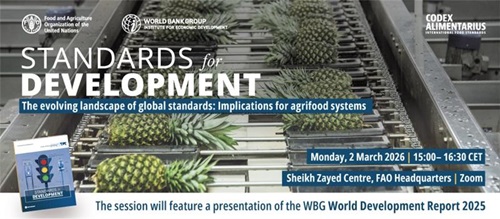
Standards for Development: World Bank and Codex to host high-level webinar
On 2 March 2026, the World Bank Group Institute for Economic Development and the Codex Secretariat will host a high-level session to discuss the role of standards in global development. With the participation...
CCRVDF27 / "Well positioned to address new challenges on the safety of veterinary drug residues"
The Codex Committee on Residues of Veterinary Drugs in Foods (CCRVDF) takes place in Omaha, Nebraska, United States of America from 21 to 25 October 2025. The Committee will be chaired for the second time...
.tmb-thb5x4.jpeg?Culture=en&sfvrsn=130e936e_1)
CCFFP36 / Codex Committee meets for the second time by correspondence
The Codex Committee on Fish and Fishery Products begins its 36th session on Monday 7 Otober 2024. Meeting for the second time by correspondence via the Codex online platform, CCFFP36 is set to complete...
CCNFSDU / Building active, open exchange and achieving consensus
The forty-fourth meeting of the Codex Committee on Nutrition and Foods for Special Dietary Uses (CCNFSDU) will take place 2–6 October in Dresden, Germany. We spoke to Martine Püster and Carolin Bendadani,...
Codex and the SDGs – input to the High-Level Political Forum
The Ministerial segment of the High-Level Political Forum on Sustainable Development (HLPF) meets this week, to review progress on a cluster of Sustainable Development Goals (SDGs). The Codex Alimentarius...
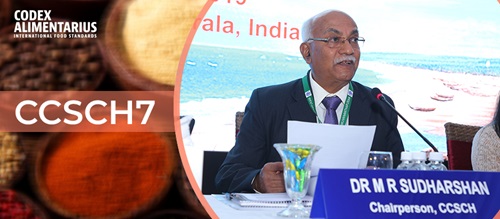
CCSCH7 / “Preparation, transparency, collaboration and inclusiveness” - Dr M. R. Sudharshan gears up for CCSCH
The Seventh Session of the Codex Committee on Spices and Culinary Herbs (CCSCH7), 29 January – 2 February 2024, Kochi, Kerala, India, will open the 2024 cycle of meetings of Codex Subsidiary Bodies. We...
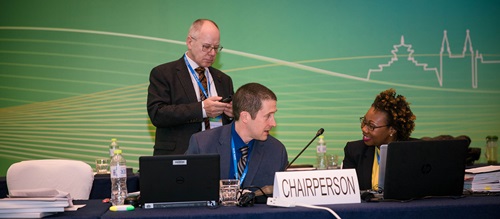
CCFA53 / pre-session working groups pave the way for a smooth meeting
The Codex Committee on Food Additives is renown for its physical working groups that lead up to the full plenary which beings on Monday 27 March, 2023. These groups carry out the groundwork for the topics...
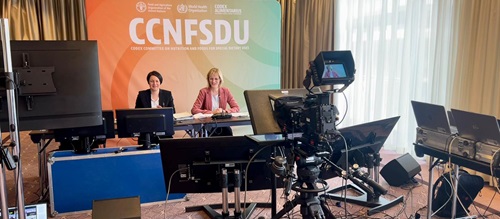
CCNFSDU / willingness to complete work ensures follow-up formula text adopted
The Codex Committee on Nutrition and Foods for Special Dietary Uses (CCNFSDU) met virtually on 15 March 2023 to successfully adopt the report of the session, sending the “Standard for Follow-Up Formula...
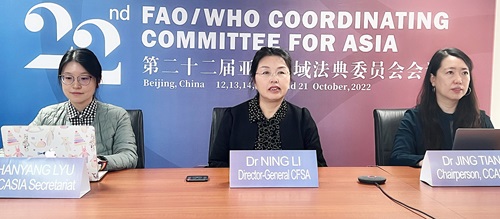
CCASIA22 / promoting food trade and technological cooperation for global food safety
The FAO/WHO Coordinating Committee for Asia (CCASIA22) is taking place virtually from 12 to 21 October 2022. Welcoming delegates via video message, Lei Haichao , Vice Minister of the National Health Commission...