


Understanding acrylamide

Earlier this week there were stories in the press that the UK Food Standards Agency is warning that overcooked starchy foods can contain acrylamide, a chemical liked to cancer.
Risks during high temperature cooking
Recent concern over the presence of acrylamide in food dates from 2002. Scientists reported that up to “mg/kg” quantities of acrylamide could be formed in carbohydrate-rich foods during high-temperature cooking, e.g. during frying, baking, roasting, toasting and grilling.
Acrylamide (or acrylic amide) is a chemical compound with the chemical formula C3H5NO. It is mainly formed in food by the reaction of asparagine (an amino acid) with reducing sugars (particularly glucose and fructose) as part of the Maillard Reaction (a complex series of reactions between amino acids and reducing sugars, usually at increased temperatures).
Since the 2002 discovery, major international efforts have been mounted to investigate the principal sources of dietary exposure, to assess the associated health risks and develop risk management strategies.
Codex code of practice
In 2009 the FAO/WHO Codex Alimentarius developed a “Code of Practice for the Reduction of Acrylamide in Foods” (CAC/RCP 67-2009) which intends to provide national and local authorities, manufacturers and other relevant bodies with guidance to prevent and reduce formation of acrylamide in potato products and cereal products.
How to reduce acrylamide?
- Decrease the surface area; for example in French fries, by cutting potatoes into thicker slices.
- Washing, blanching or par-boiling treatments can be employed to leach the asparagine/reducing sugar reactants from the surface of the potato before the cooking step.
- Yeast fermentation of wheat bread doughs reduces the free asparagine content.
- Where relevant, industry should endeavor to provide advice to consumers on appropriate cooking and handling instructions that can help to mitigate acrylamide formation in the product.
FAO Senior Food Safety Officer Markus Lipp explained the sources, the causes, and the risk from acrylamide and how FAO and WHO expert committees assess compounds in order to provide the best, most robust scientific advice available to Codex committees.

We examine the safety and ask what does it matter for humans in their daily lives?
Links
Related content
Celebrating one-year anniversary of the JECFA Toolbox for Veterinary Drug Residues Risk Assessment
As the 28th session of the Codex Committee on Residues of Veterinary Drugs in Foods (CCRVDF28) approaches, the FAO JECFA Toolbox for Veterinary Drug Residues Risk Assessment marks its first anniversary. This...
-jpg.tmb-thb5x4.jpeg?Culture=en&sfvrsn=2a63cdc3_1)
High-level event explores standards as a catalyst for economic growth
Standards are "the hidden infrastructure of modern economies" according to the World Bank’s World Development Report 2025, which focuses on standards for development. In a corroboration of the Codex maxim...
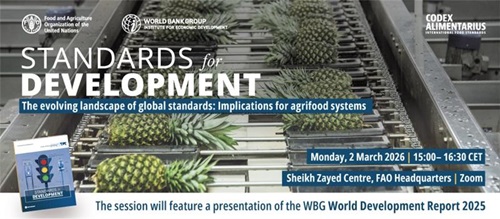
Standards for Development: World Bank and Codex to host high-level webinar
On 2 March 2026, the World Bank Group Institute for Economic Development and the Codex Secretariat will host a high-level session to discuss the role of standards in global development. With the participation...
FAO launches toolbox to assess the risks of veterinary drug residues in food
On 27 February 2025, the Food and Agriculture Organization of the United Nations (FAO) officially launched the JECFA Toolbox for Veterinary Drug Residues Risk Assessment. FAO hosted a launch event on Zoom, attracting...
Launch event / JECFA Toolbox for Veterinary Drug Residues Risk Assessment
The Food and Agriculture Organization of the United Nations (FAO) has launched a comprehensive and practical toolbox designed to help those assessing the risks of veterinary drug residues in food. The...
CCRVDF27 / "Well positioned to address new challenges on the safety of veterinary drug residues"
The Codex Committee on Residues of Veterinary Drugs in Foods (CCRVDF) takes place in Omaha, Nebraska, United States of America from 21 to 25 October 2025. The Committee will be chaired for the second time...
.tmb-thb5x4.jpeg?Culture=en&sfvrsn=130e936e_1)
CCFFP36 / Codex Committee meets for the second time by correspondence
The Codex Committee on Fish and Fishery Products begins its 36th session on Monday 7 Otober 2024. Meeting for the second time by correspondence via the Codex online platform, CCFFP36 is set to complete...
CCNFSDU / Building active, open exchange and achieving consensus
The forty-fourth meeting of the Codex Committee on Nutrition and Foods for Special Dietary Uses (CCNFSDU) will take place 2–6 October in Dresden, Germany. We spoke to Martine Püster and Carolin Bendadani,...
Codex and the SDGs – input to the High-Level Political Forum
The Ministerial segment of the High-Level Political Forum on Sustainable Development (HLPF) meets this week, to review progress on a cluster of Sustainable Development Goals (SDGs). The Codex Alimentarius...