


Steve Wearne talks AMR for Codex
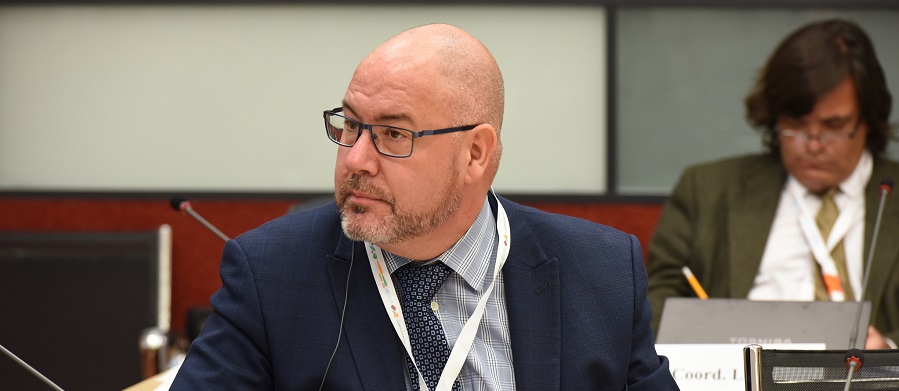
Steve Wearne is Director of Policy and Science Group at the UK Food Standards Agency and In July 2017 he was elected as Vice Chair of the Codex Alimentarius Commission. He also chaired the 2016 Codex physical Working Group on antimicrobial resistance in London.

For Antimicrobial Awareness Week we spoke to Steve about the importance of antimicrobial resistance as an issue, about the agricultural use of antimicrobials, and about national and international action on the issue, of which the work of Codex Alimentarius forms a vital part.
Just how important is antimicrobial resistance – or AMR – as an issue?
Put simply, the emergence of AMR poses a significant global threat that might change the very nature of medicine. Lord O’Neill, in his authoritative report commissioned by the UK Government, says that without action at the global level, by the middle of this century there would be an extra 10 million deaths each year as a result of AMR and it will overtake cancer as the biggest cause of death.
So, is agricultural use of antimicrobials an issue?
Both pathogenic and non-pathogenic resistant bacteria can be transmitted from livestock to humans via food consumption, or via direct contact with animals or their waste in the environment. Any mechanism that helps spread bacteria has the potential to transfer resistant bacteria.
And so the food distribution network is a theoretical risk pathway for transmission and spread from animals to humans. Despite this, direct evidence for AMR in humans resulting from consumption of food products is very limited. So our knowledge is incomplete. However, there is an increasingly robust consensus that unnecessary use of antimicrobials in animals and agriculture is a significant concern, and that minimising the unnecessary and inappropriate use of antimicrobials is an essential component of global AMR strategies.
So, what is happening?
Well, the world is waking up to AMR risks. There has been a huge effort at the international level to drive forward the AMR agenda over the past 2-3 years. Last September’s declaration on AMR by the UN General Assembly is a real milestone.
Here in the UK, we have committed to achieving a target for multispecies average use of antibiotics of 50 mg/kg by 2018, which represents a 20% reduction in use in four years. We are also setting sector specific reduction targets this year so that future reductions are greatest where there is most scope. We are setting rules for antibiotics which are most critically important for human health, reserving their use in animals as a last resort, and only where there is a diagnosed disease, no alternative treatment and only after conducting an antibiotic susceptibility test.
The UK has also committed US$375m to the Fleming Fund to improve disease surveillance, focused on drug-resistant infections in low and middle-income countries.
And what is the role of Codex Alimentarius?
The Codex Alimentarius Commission agreed in July 2016 to re-establish the Intergovernmental Task Force on Antimicrobial Resistance in order to revise and update the Codex code of practice on AMR and, for the first time, to set guidelines for integrated AMR surveillance that can be adopted by Codex member countries in a stepwise manner to reflect their capabilities. These new texts would complement the national plans that many countries are developing, rather than distract from them.
I was honoured to chair the physical Working Group in London in November and December 2016, along with my co-chairs from Australia and the USA. We succeeded in achieving a broad consensus in London on the project documentation that sets the scope of this new work. I’m hopeful that this can provide a firm basis for the work to be done.
We also identified the important role that science has to play in underpinning the work of the Task Force, and set out some initial science priorities for FAO and WHO.
Momentum is now key. We need to focus our efforts on preparing for the first meeting of the Task Force later this year, and do all we can to assure its success.
Links
Related content
-(cropped).tmb-thb5x4.jpeg?Culture=en&sfvrsn=21f367b3_1)
CCEXEC89 / Executive committee deliberations start ahead of the 48th Commission meeting
The 89th Session of the Codex Executive Committee (CCEXEC) has commenced at FAO headquarters in Rome, ahead of the 48th Session of the Codex Alimentarius Commission (CAC), which will be held in the week...
CCEXEC87/ Codex’s executive rounds off a busy year ahead of the 47th Commission meeting
The 87th session of the Codex Alimentarius Executive Committee (CCEXEC87) has started at the International Conference Center Geneva to discuss issues outstanding before the meeting of the 47th Codex Alimentarius...
Importance of Codex standards showcased at the 8th Shenzhen Food Safety Forum
by Awilo Ochieng Pernet, Former Chairperson of the Codex Alimentarius Commission The 8th Shenzhen Food Safety Forum 2024, which took place on 5-6 November 2024 in Shenzhen (China) highlighted the importance...
CCEXEC86/ "Respond to the emerging challenges while leaving no one behind"
In opening remarks to the 86th session of the Executive Committee of the Codex Alimentarius Commission (CCEXEC86), taking place at FAO Headquarters 1-5 July 2024, Maria-Helena Semedo, Deputy Director-General,...
CCEXEC86/ Steve Wearne "Collaboration key to making progress"
With the 86th Session of the Executive Committee of the Codex Alimentarius Commission (CCEXEC86) starting next week at FAO HQ, Rome, the Codex Secretariat sat down with the Chairperson, Steve Wearne (United...
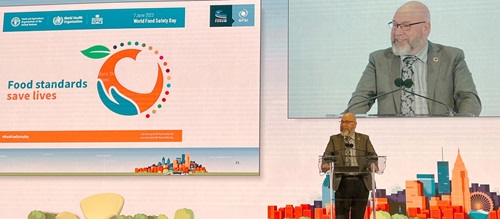
Steve Wearne / global challenges require rules on trade fit for the future
Speaking on Wednesday 26 Aprile, 2023, at the 22nd annual Global Food Safety Initiative (GFSI) Conference, in Atlanta, Georgia, the United States of America, Codex Chairperson Steve Wearne said: “Our systems...

CAC45 / Steve Wearne outlines conduct of discussions on zilpaterol
The Chairperson of the Codex Alimentarius Commission, Steve Wearne, United Kingdom, in consultation with the Vice-Chairpersons and the Codex Secretariat has published a letter to Codex Members and Observers...
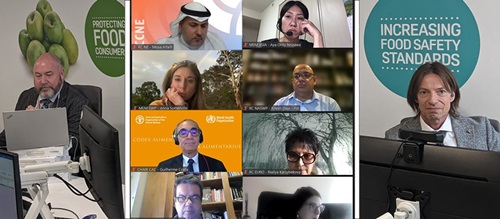
CCEXEC / sub-committee on strategic planning holds virtual session
The strategic planning sub-committee of the Executive Committee of the Codex Alimentarius Commission met virtually on 1 July 2021. One of the tasks of the group is to consider how Codex can contribute...

Incoming regional coordinators learn the key to Codex work
In the second of a series of online webinars organized by the Codex Secretariat for the incoming coordinators representing the six regions in the Codex Alimentarius Commission, the focus was on their role...