


Food safety experts from 23 African countries trained on good laboratory practices
.jpg?sfvrsn=f0aacd6_0)
By Hakim B. Mufumbiro, Regional Coordinator, FAO/WHO Coordinating Committee for Africa
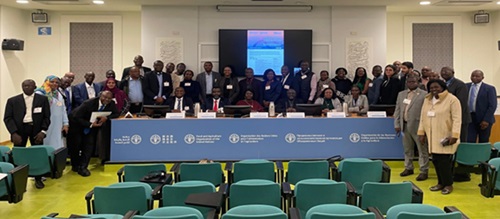
Food Safety Experts drawn from 23 African countries (Benin, Botswana, Burkina Faso, Burundi, Cabo Verde, Congo, Djibouti, Egypt, Eswatini, Ethiopia, Kenya, Madagascar, Malawi, Mauritania, Morocco, Namibia, Nigeria, Rwanda, Senegal, Togo, Tunisia, Uganda and Zimbabwe) completed an intensive 5-day training session on Good Laboratory Practices (GLP) for animal disposition studies that was held in Rabat, Morocco ,31 March to 4 April 2025. The main purpose of the training was to build regional capacity and knowledge in good laboratory practices to support the process of food safety standard-setting when using large food animals.
The regional training was supported through a Technical Cooperation Project (RAF5091) on Enhancing human and analytical capacities for food safety standards coordinated by the International Atomic Energy Agency (IAEA). The project aims at addressing a critical gap in Africa’s food safety system, the need to establish or contribute to the setting of national, regional and international (Codex) standards and guidelines, required to safeguard consumers, ensure responsible food production practices and facilitate fair trade in agricultural products. Key deliverables from the project include the enhanced technical capacity for personnel and laboratories needed to conduct radio-labelled and non-radio-labelled activities for standards setting as well as supervised field trials.
Support will also be extended to improvement of food safety policy and regulatory framework(s) and enhancing surveillance programmes within the Member Countries, which contributes to the effective implementation of the continental food safety strategy and, ultimately, to fostering increased intra-African trade in food and agricultural products.
This training contributes to building the strong and sustainable capacity for Member Countries required to generate reliable scientific data that will be used for setting maximum residue limits (MRLs) and/or maximum levels (MLs) for a range of chemical hazards including veterinary and pesticide residues, mycotoxins and toxic metals, for a broad scope of foodstuffs.
While officiating at the opening of the regional training, Dr Sami Darkaoui, the Head of Division of Pharmacy and Veterinary Inputs at the Moroccan Office for Food Safety (ONSSA) underscored the need for the continent to build robust food safety assessment systems, which is important in contributing to regional and international standardization efforts. Dr Darkaoui further advised that study designs should be conducted in line with GLP requirements. He noted that additional capacity development events were planned to be held in May 2025 focussing on GLP in the area of pesticide residues, including attention to minor crops.
The trainees welcomed the initiative and continued support from IAEA which will go a long way in harmonizing the application and implementation of good laboratory practices in the continent.
Read more
Photo credit: Muhammed Ait Lachguer
Related content
High-level advocacy event strengthens Africa’s commitment to food safety and Codex participation
by the CCP of The Gambia On the margins of the 49th Session of the Codex Alimentarius Commission (CAC49), The Gambia, in its capacity as Coordinator of the FAO/WHO Coordinating Committee for Africa (CCAFRICA),...
CCFA56 / Strengthening Africa’s voice in international food additives regulation
by the Codex Contact point of Uganda Twelve CCAFRICA Member Countries, including Cabo Verde, Cameroon, Côte d’Ivoire, Ghana, Kenya, Morocco, Nigeria, Senegal, South Africa, Sudan, Uganda, and the United...
The East African Community is leading the way on gum arabic standard setting
With the support of the European Union-funded Market Access Upgrade Programme Phase II (MARKUP II), which is implemented through the International Trade Centre (ITC), the East African Community (EAC) partner...
CCAFRICA delegations lead collaborative efforts in Kuala Lumpur
by the Codex Contact Point of Uganda and the Coordinator for CCAFRICA The Codex Committee on Fats and Oils (CCFO) held its 29th Session in Kuala Lumpur, Malaysia, bringing together member countries and...
-jpeg.tmb-thb5x4.jpeg?Culture=en&sfvrsn=6e98bd36_1)
CCAFRICA Coordination officially handed over in Banjul, The Gambia
The FAO/WHO Coordinating Committee for Africa (CCAFRICA) celebrated a significant milestone on 26 January 2026, with the official handover ceremony of the CCAFRICA Coordinator from Uganda to The Gambia....
CAC48 / African missions in Rome commit to stronger Codex engagement
By Hakim B. Mufumbiro, Codex Office, UGANDA On the margins of the recently concluded 48th Session of the Codex Alimentarius Commission (CAC48), a high-level advocacy event for African Missions in Rome...
National training drives effective participation of Rwanda in Codex
by Rosine Niyonshuti, CCP Rwanda From 10 to 13 November 2025, the Rwanda Standards Board (RSB), in the capacities of Rwanda’s Codex Contact Point, held a training workshop for members of the National Codex...
.tmb-thb5x4.jpeg?Culture=en&sfvrsn=7c2b0df8_1)
CAC48 / African parliamentarians are urged to advocate for Codex in a Commission side event
An event titled “Bridging the gap between the parliamentary community and Codex” was held in the margins of the 48th Codex Alimentarius Commission meeting Tuesday and brought together key Codex and FAO...
.tmb-thb5x4.jpeg?Culture=en&sfvrsn=688012e9_1)
African delegates boost skills in Codex engagement and negotiations at BTSF training in Nairobi
Nairobi, Kenya, 3 October 2025 – Delegates from across Africa gathered in Nairobi for an intensive three-day workshop to sharpen their skills in participating in all aspects of Codex work. Organized under...