


CCMAS44 / A virtual opportunity to strengthen international food standards
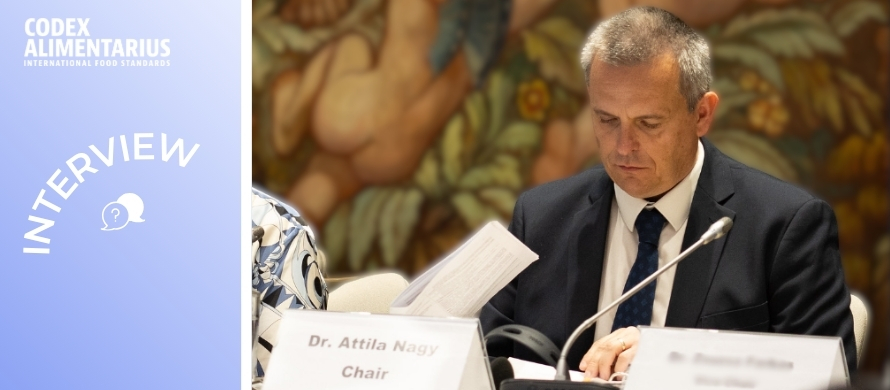
The 44th session of the Codex Committee on Methods of Analysis and Sampling (CCMAS44) will be held in a virtual format from 5 to 8 May, with report adoption on 14 May. While time zone differences remain a logistical hurdle, the virtual setting opens doors for broader participation from Members, Observers and overall experts worldwide. We recently spoke with Attila Nagy to gain insights into the agenda of CCMAS44, including the review of methods of analysis and sampling plans in CXS 234-1999, and his perspective on how CCMAS continues to underpin the Codex mission of protecting consumer health and facilitating fair practices in food trade.
Attila, thanks for your time. This year the Codex Committee on Methods of Analysis and Sampling will be held virtually. In your letter to the delegates, you mention that meeting this way will give a “chance to connect more widely and flexibly, ensuring greater participation and collaboration”.
Indeed, I believe that although unforeseen circumstances required changes in the organization of the event, the virtual format provides an opportunity for all member to join the meeting and for all interested experts to participate—regardless of the usual size of their delegations able to travel to Budapest in person. The only challenge we cannot yet overcome—short of time travel—is the difference in time zones. All other difficulties are well understood and managed.
The provisional agenda of CCMAS44 includes the review of methods of analysis and of the sampling plans in CXS 234-1999. What challenges do you foresee in updating them, if any?
I am very pleased that the review of the standard is progressing well year after year. This year, it will be expanded with a new group of commodity packages, and I am hopeful that we will be able to finalize a significant number of areas. Harmonization always presents considerable challenges, especially in areas where there is no active committee. In such cases, if a provision requires amendment or further consultation, we must work together with the Codex Secretariat to find a suitable solution.
Talking about CXS 234-1999, could you please explain the usefulness of this standard for countries and its impact on Codex work?
Codex standards establish safety and quality requirements for everyday categories of food products. A limit value requirement can only be considered complete when appropriate sampling and analytical methods are also recommended for use by experts from member countries. It is my personal mission to ensure that Standard 234—and the resulting database—serves as a comprehensive information resource, providing a solid starting point for all laboratory colleagues when making decisions about method selection.
As you've frequently said, CCMAS plays a pivotal role in harmonising analytical methods globally. How are you preparing to facilitate discussions amongst diverse Codex Members and Observers to balance technical rigour with practical applicability during the session?
I firmly believe in the importance of understanding everyone’s perspective—as it is through this that we come to understand their underlying interests. If we can bring these to light with honesty, we are already halfway toward achieving the difficult task of building consensus. In my experience, both with member countries and observers, I have been fortunate: active dialogue has always yielded results—if not during a single committee session, then shortly thereafter.
A working group on endorsement of methods of analysis is scheduled to meet just before the main session. How do you expect these pre-session discussions to shape the Committee’s work?
This year’s virtual physical working group once again plays a crucial preparatory role in facilitating the plenary session and in identifying solutions. The Chair and Co-Chairs of the working group review the endorsement-related matters that form the backbone of CCMAS, with the participation of nearly the full membership. Following prior coordination and informal exchange, the report on the amendments to Standard 234 is presented to the plenary session. A key advantage of this approach is that technical elements on which there is consensus can be swiftly endorsed by member country representatives after a brief plenary review.
One final question. How do you envision the 44th CCMAS session contributing to the Codex mission of protecting consumer health and promoting fair practices in food trade?
This year, we are continuing the modernization of sampling methods, and both the information document and the accompanying e-book are gradually taking their final form. A scientifically sound sampling approach is essential for every inspection, as it ensures that subsequent laboratory analyses can safeguard consumer health with the highest possible accuracy—or, in the case of quality concerns, protect the interests of trading partners.
As I have mentioned before, Codex standards—together with the supporting rules of CCMAS—are key to fully ensuring our overarching goal: that safe, high-quality, and accessible food is available on everyone’s table.
Read more
Related content
CCMAS45 / "A guarantee that the best regulations can be developed"
Attila Nagy has been Chairperson the Codex Committee on Methods of Analysis and Sampling (CCMAS) for almost a decade, and has previously served as Vice-chairperson of the committee. He is a passionate...
“The beating heart of Codex” – Interview with Codex Secretary, Sarah Cahill
As the Codex Alimentarius Commission (CAC) returns to its traditional July meeting cycle, Codex Secretary Sarah Cahill outlines the roadmap for 2026 and beyond. In this recent interview, she details how...
"Built on science, consensus and cooperation"
At the conclusion of 2025, the Chairperson of the Codex Alimentarius Commission, Allan Azegele (Kenya), sat down with the Codex Secretariat to review the outcomes of the 48th Session of the Commission,...
Safety, science, and standardization: CCFH to address food hygiene priorities in Nashville
The 55th session of the Codex Committee on Food Hygiene (CCFH) will close the cycle of Codex meetings for 2025. As delegates prepare to meet in Nashville, Tennessee, United States of America, we sat down...
“A shared responsibility” - Allan Azegele to chair his first Codex meeting
The 88th Session of the Executive Committee of the Codex Alimentarius Commission (CCEXEC88) will take place at FAO Headquarters in Rome 14–18 July 2025. As Allan Azegele, Chairperson of the Codex Alimentarius...
New website simplifies analytical methods for special dietary foods
A new "Test Methods for Special Dietary Foods" website has been launched by the International Special Dietary Foods Industries (ISDI), supported by AOAC International and the International Dairy Federation....
CCCF18 / "Complex issues with real-world impact"
The Eighteenth Session of the Codex Committee on Contaminants in Foods (CCCF18) will take place 23–27 June 2025 in Bangkok, Thailand. We spoke to Sally Hoffer, from the Dutch Ministry of Agriculture, Nature...
CCGP34 / “The world needs Codex, Codex needs CCGP”
As the Codex Committee on General Principles (CCGP) celebrates its 60th anniversary, we spoke with its Chairperson, Jean-Luc Angot, who has led the Committee since his appointment in 2018. With the 34th...
"Engagement and commitment" - Codex Secretary on a productive year for Codex
As 2025 begins, we asked Codex Secretary Sarah Cahill to reflect on the past year, and these are her thoughts. With 17 meetings, hundreds of newly adopted standards and a new Strategic Plan, 2024 was...