


CAC48 / Coming soon: a new standard for Codex, thanks in part to the Codex Trust Fund
The Codex Trust Fund (CTF) is facing challenges that may mean it will have to be restructured, changed, re-thought. But this should not detract from the incredible impacts that it has been and still is responsible for. In line with the aims of the project to help countries build Codex capacities and structures and participate more effectively in Codex standards development, CTF projects have brought countries together, fostered confidence among national stakeholders, helped to enhance awareness, and promoted policy action. The CTF has also contibuted to a new Codex standard: the standard for large cardamom.
Bhutan participated, alongside India and Nepal, in the first ever CTF group project. The group approach proved to be beneficial for all concerned, and fostered closer relations between the respective food safety authorities and confidence at a subregional level in the possibilities involved in collectively recognizing what Codex work could benefit them all. To close the project, a “terminal meeting” in Thimphu, Bhutan, saw the participants review their achievements. At that meeting, the countries realised the new power they had to go ahead and propose Codex work that would bolster their own agrifood sectors. Bhutan decided then to propose a standard for large cardamom. The standard has now been agreed by the Codex Committee on Spices and Culinary Herbs, and has been forwarded for adoption, with food additives and food labelling provisions pending.
We spoke with Dechen Wangmo, Bhutan’s Chief of the Food Quality and Safety Division, Bhutan Food and Drug Authority, and chair of the large cardamom electronic working group, to ask about this experience.
First of all, many congratulations on the success of the standard for large cardamom! What does this mean to you and to Bhutan? What impact to you anticipate the standard will have on Bhutan’s cardamom sector?
Bhutan, being one of the key producers and exporters of large cardamom alongside India and Nepal, is expected to greatly benefit from the adoption of this standard. The standard will help harmonize Bhutan’s production and export practices with international requirements, thereby enhancing product quality, safety, and market credibility. This, in turn, will enable Bhutanese exporters to access and compete more effectively in global markets, expand export opportunities, and strengthen the reputation of Bhutan’s cardamom as a premium product.
In what ways did the CTF group project contribute to Bhutan’s proposal to develop a standard for large cardamom? Would it be accurate to say the CTF can claim some responsibility for this standard?
The Codex Trust Fund (CTF) Group Project, started in 2019, helped Bhutan strengthen its national Codex system and build the skills of officials to take part in international food standard work. Through training, cooperation with Nepal and India, and improved coordination, Bhutan gained the knowledge and confidence to propose its own standard for large cardamom. Therefore, the CTF project can rightly be said to have contributed to Bhutan’s initiative to develop this standard. Moreover, the standard was jointly developed by three countries, with Bhutan serving as the Chair and India and Nepal as Co-Chairs.
How has Bhutan changed its approach to Codex as a result of the CTF project?
As a result of the CTF project, Bhutan has adopted a more structured, proactive, and collaborative approach to Codex work. The project helped strengthen the national Codex system, improve coordination among stakeholders, and build the technical skills of officials to actively participate in international standard-setting. Bhutan has moved from being a passive participant to taking leadership roles, such as chairing the development of the large cardamom standard with India and Nepal as co-chairs. This reflects Bhutan’s stronger confidence, better organization, and increased engagement in Codex activities at both national and international levels.
What advice do you have for other CTF eligible countries that maybe would like to improve their Codex capacities?
For other CTF-eligible countries looking to strengthen their Codex capacities, it is important to focus on building strong national Codex structures, including clear governance, coordination mechanisms, and communication channels among stakeholders. Investing in capacity building of officials through training, mock exercises, and study visits helps develop technical skills and confidence for participation in international standard-setting. Regional collaboration with neighboring countries can provide valuable experience and knowledge sharing. Finally, prioritizing active engagement and leadership in Codex activities, rather than just participation, allows countries to influence standards that reflect their national interests and export priorities.
And do you have a message for the donors to the CTF and any prospective donors to future Codex capacity building initiatives?
We would like to sincerely thank the donors to the Codex Trust Fund (CTF) for their generous support, which has been instrumental in strengthening Bhutan’s Codex system, building the capacity of our officials, and enabling active participation in international standard-setting. Your investment has empowered us to take leadership roles, improve national coordination, and develop standards that support our export sectors, such as the large cardamom standard. To prospective donors, we encourage continued support for Codex capacity-building initiatives, as such investments not only enhance food safety and trade opportunities but also strengthen the technical and institutional foundations of participating countries for years to come.
Read more
Codex Trust Fund
CAC48 webpage
Download the CODEX magazine
Related content
.tmb-thb5x4.jpeg?Culture=en&sfvrsn=33d295f8_1)
The 6th Global Conference on Foodborne AMR successfully held in Seoul, highlighting the achievements of the ACT Project
The 6th Global Conference on Foodborne Antimicrobial Resistance (GCFA) was successfully held on 13 May 2026 in Seoul, Republic of Korea. The conference has become an important international platform for...
ACT project to share experiences at the 6th Global Conference on Foodborne AMR
The FAO-implemented Action to support implementation of Codex AMR texts (ACT) project will share its experiences and challenges at the 6th Global Conference on Foodborne Antimicrobial Resistance (GCFA),...
.tmb-thb5x4.jpeg?Culture=en&sfvrsn=de5f6081_1)
ACT / Pakistan strengthens One Health response to foodborne antimicrobial resistance at national conference
Pakistan is stepping up efforts to address foodborne antimicrobial resistance (AMR), one of the most pressing threats to public health, food safety and sustainable agriculture, through a strengthened One...
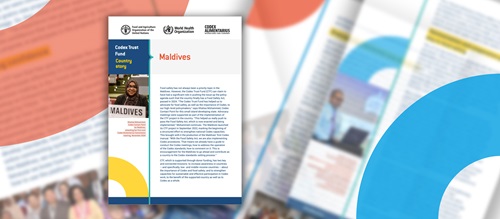
CTF / New success story from the Maldives shows a strengthened national food safety system
A new Success Story published by WHO and FAO demonstrates how support from the Codex Trust Fund (CTF) has helped the Maldives strengthen its national food safety system and improve its effective participation...
-jpg.tmb-thb5x4.jpeg?Culture=en&sfvrsn=73645107_1)
ACT / Cambodia Strengthens Capacity on Costing and Budgeting for its Multi Sectoral Action Plan on AMR
Siem Reap, Cambodia – 25 February 2025 The Food and Agriculture Organization of the United Nations (FAO), through the Action to support implementation of Codex AMR texts (ACT) project funded by the Ministry...
-(cropped).tmb-thb5x4.jpeg?Culture=en&sfvrsn=7dba5d40_1)
ACT / Cambodia strengthens feed inspection capacity to combat antimicrobial resistance
Cambodia is stepping up efforts to curb antimicrobial resistance (AMR) in livestock production by improving the skills of its feed inspectors. From 3–5 December 2025, the Food and Agriculture Organization...
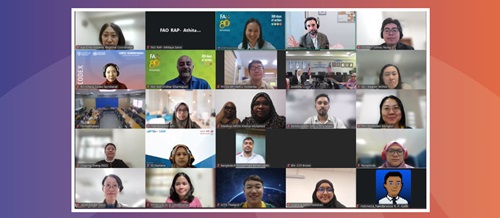
Regional workshop strengthens use of the Codex online commenting system in Asia
Building on the positive momentum following the 23rd Session of the FAO/WHO Coordinating Committee for Asia (CCASIA23), the FAO Regional Office for Asia and the Pacific (FAO RAP) under the regional project...
.tmb-thb5x4.jpeg?Culture=en&sfvrsn=9761ba6a_1)
Codex Trust Fund strengthens regional capacity in South Asia
Guwahati, Assam, 17 October 2025 The Codex Committee on Spices and Culinary Herbs (CCSCH) agreed at its 8th session, held 13–17 October, to forward the standard for large cardamom for adoption. The success...
.tmb-thb5x4.jpeg?Culture=en&sfvrsn=8d7fa640_1)
Global Food Regulators Summit 2025 highlights Codex leadership and regional collaboration
India hosted the third edition of the Global Food Regulators Summit (GFRS) 2025 at Bharat Mandapam, New Delhi, bringing together over 3500 delegates from 59 countries to advance international cooperation...