


WAAW/ ACT project is helping the Plurinational State of Bolivia tackle the threat of foodborne AMR
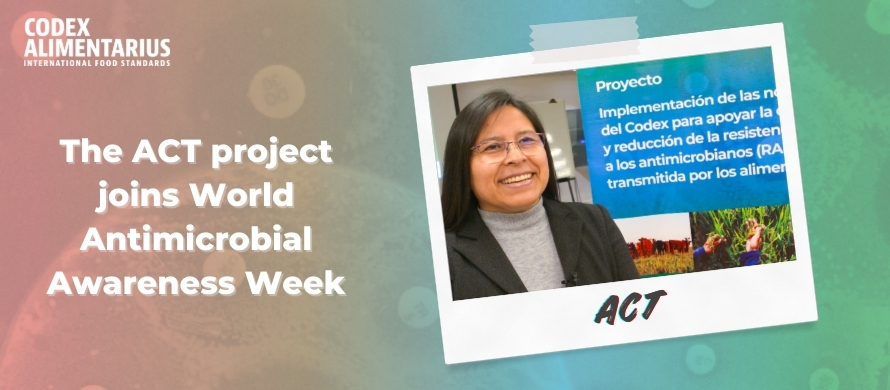
The FAO-implemented and Republic of Korea-funded Action to support implementation of Codex AMR texts (ACT) project is being carried out in six countries, of which one is the Plurinational State of Bolivia. Here, the Project has made great progress in helping the national authorities improve governance of the threat of antimicrobial resistance (AMR) and has supported training to improve surveillance and monitoring of foodborne AMR.
Carolina Tejerina is a protagonist in these activities, and we spoke with her to find out more about the ACT Project successes in her country.
1. Could you describe your professional career and your work in the Plurinational State of Bolivia Bolivia, in relation to AMR?
All my professional experience is in food. After training as a biochemical pharmacist, I started working as the quality manager in small food factories. Then in 2005, I started working as an inspector for the National Service of Agricultural Health and Food Safety, (SENASAG). I was put in charge of food safety registration and certification. Since then, I have held several positions (Departmental Manager for Food Safety, National Manager for Food and Residue Analysis Laboratories, National Manager for Surveillance and Control of Residues and Contaminants in Food) and I am currently working as a Waste and Contaminants Surveillance and Control Professional.
I started working on foodborne AMR in 2016 after the publication of WHO’s Global Action Plan (GAP) on Antimicrobial Resistance. As a result of the GAP, I was appointed the Bolivian representative from the National Food Safety Unit at a regional meeting convened by the Pan American Health Organization (PAHO) in Peru. That is where I learned that this AMR problem is not specific to human health, but that it is relevant in all sectors. After this meeting, I was appointed focal point for foodborne AMR of the National Food Safety Unit to the Ministry of Health, to work on the formation of a National Multisectoral Committee for the Containment of AMR. It was in 2023 that the National Committee for the Containment of Antimicrobial Resistance in Agricultural Health and Food Safety, was established, with the support of the FAO ACT Project. This includes stakeholders from the private production sector as well as the pharmaceutical industry (for animals) and suppliers of agricultural and livestock inputs, together with professionals from the government.
2. Please, could you tell us why tackling foodborne AMR is important for the Plurinational State of Bolivia.
In Bolivia, antimicrobials aren’t always used as they should be. This is due to self-medication and a lack of knowledge about the importance of responsible use. In terms of animal and plant production, the use of antimicrobials is needed but by not specifying the appropriate use of antimicrobials within good production practices, it is a risk for inappropriate and irresponsible use of antimicrobials and the generation of AMR.
By spreading awareness about good practices in the use of antimicrobials, the probability of generating AMR in zoonotic microorganisms can be minimized. Information has been generated at the research level regarding AMR in pathogenic microorganisms isolated in food, however, the analysis of the data generated has not yet been carried out. The aim is to obtain structured information to present it to the authorities and all those involved through the tools that the ACT project has been managing, with the use of the WHONET software and the InFARM platform.
3. Explain what the CC-RAM is and how it fits into Bolivia's objectives to address the threat of foodborne AMR.
The CC-RAM is the National Committee for the Containment of Antimicrobial Resistance in Agricultural Health and Food Safety. The Committee is part of Bolivia's aims to address the threat of foodborne AMR through the participation of representatives from the public and private sectors (producers, suppliers of agricultural and livestock inputs), as well as professional associations. Through the Committee we aim to address the problem in a complementary and coordinated manner with each of these stakeholders.
Thus, since the members of this committee are directly involved in agricultural and livestock production, they collectively contribute to better governance of AMR and to the generation of structured and organized regulations in line with national realities.
CC-RAM has aroused much interest in the positive outcomes already seen from the ACT project. For this reason, this committee will contribute positively to activities planned for the project, such as the preparation of manuals of good practices in production for the different species, as well as the possible implementation of electronic veterinary prescriptions.

The Codex guidelines on AMR surveillance provide the approach that the primary sector in the country should adopt or adapt according to its reality.
4. In line with the Codex Guidelines on Integrated Monitoring and Surveillance of Foodborne Antimicrobial Resistance, CC-RAM is promoting the implementation of an AMR surveillance plan in healthy animals:
What is expected to be achieved? What is the objective?
Initially, CC-RAM was involved in prioritizing a sector for the implementation of AMR surveillance in healthy animals in the line with the Codex Guidelines, where it was decided to prioritize poultry production. Initially, the intention is to generate the first surveillance experience so that in the short or medium term it can be extended to other sectors (bovine, porcine and fish). The initial objective of the implementation of this plan is to generate a baseline to be able to have objective data regarding the issue of AMR in healthy animals in Bolivia, to take more concrete actions in risk management and move forward in the next stage of integrated surveillance.
How does SENASAG plan to do it? What are the steps?
Initially, the aim is to establish the plan for monitoring AMR in healthy animals (birds), with the support of FAO experts through the ACT project, and then to disseminate it within the production sector involved, in order to organize the sampling. We will also carry out the training of official veterinarians and accredited veterinarians so that they can carry out the sampling destined for the national laboratories network (UNALAB laboratories) of SENASAG.
How will the training work in the UNALAB laboratories contribute to the execution of the plan?
The training of technical personnel being carried out in the UNALAB laboratories is fundamental, because in this way it will contribute to the quality assurance of the analysis for the generation of reliable reports, which will contribute to accurate decision-making.
How will the work be coordinated with the private sector? How do you think the different sectors of animal production will react?
Considering that the prioritization of the species to start the surveillance of AMR in healthy animals has been carried out in coordination with the production sector, it is expected that the execution of the sampling plan will be fulfilled accordingly. The production sector initially reacted negatively, however, after explaining to them the purpose of the sampling plan, they understood that the activity will also contribute positively to the sector.
As we understand it, the national representatives of the bovine sector in the country have indicated that they wish to implement a surveillance plan at a national level to help monitor AMR in their sector. Can you explain the factors that motivate this statement?
The bovine working group in CC-RAM has initially expressed interest in developing a sampling plan for the surveillance of AMR in live animals. This has been motivated by increasingly stringent export requirements, and participating in the AMR surveillance plan would provide the scientific information needed for taking timely actions.
With each meeting held within the CC-RAM, we see increasing participation. For this reason, it seems likely other sectors would also be interested in developing a sampling plan for monitoring AMR in.
What importance do the Codex surveillance guidelines have for the sector's plans?
The Codex Guidelines are particularly important because they have been developed in coordination with the different experts from the international organizations involved, as well as the participation of national experts who are members of the different health services. The Codex guidelines on AMR surveillance provide the approach that the primary sector in the country should adopt or adapt according to its reality.
How can CC-RAM help in the implementation of the surveillance plan?
CC-RAM will help in the implementation of the surveillance plan through the coordination that has already begun, and as a manager for taking actions in cases where some difficulties may arise. For example, if there were a lack of personnel for sample collection, some type of support could be requested from the College of Veterinary Doctors or through universities to obtain the support of final-year students of the courses involved, such as the Veterinary Medicine Degree, among others.
5. In your professional opinion, after applying the surveillance plan in healthy animals, what could be the next steps for the surveillance system in the Plurinational State of Bolivia? What could be the result of this work?
Taking an optimistic view, the next step to follow would be to develop a surveillance plan in food that complements the one being prepared for healthy animals. With this we will be moving forwards to integrated surveillance. The objective of this work is to generate the objective data needed to involve and work with the Ministry of Health in the risk management of foodborne AMR.
Read more
World Antimicrobial Awareness Week at FAO
World Antimicrobial Awareness Week at WHO
The ACT project
The InFARM platform
Related content
Strengthening Grenada's voice in global food standards
by the Codex Contact Point of Grenada On 5 June 2026, the Grenada Bureau of Standards hosted a training session for members of the National Codex Committee and the GDBS team, facilitated by Giuseppe...
.tmb-thb5x4.jpeg?Culture=en&sfvrsn=4561bf2b_1)
ACT / Colombia and the Plurinational State of Bolivia strengthen antimicrobial resistance surveillance
Colombia and the Plurinational State of Bolivia are stepping up efforts to tackle antimicrobial resistance (AMR), one of the world’s most pressing health threats, by strengthening laboratory surveillance...
.tmb-thb5x4.jpeg?Culture=en&sfvrsn=d6cd33d9_1)
ACT / Surveys in Latin America provide key recommendations for increased awareness about foodborne AMR
One of the aims of the Action to support implementation of Codex AMR texts (ACT) project is to raise awareness among stakeholders along the food production chain, about the need for responsible and prudent...
.tmb-thb5x4.jpeg?Culture=en&sfvrsn=8634eb_1)
ACT / Bolivian authorities forge ahead with the introduction of e-prescriptions for veterinary antimicrobials
Great progress was made in the fight against antimicrobial resistance (AMR) in the Plurinational State of Bolivia at the end of January, when officials and professionals met to agree on next steps for...
Fresh perspectives: an interview with the new Chairperson of CCFFV23
Members and Observers from over 30 countries will meet in Mexico City, Mexico, from 25 February to 1 March 2025 to develop standards at the 23rd session of the Codex Committee on Fresh Fruits and Vegetables...
Simulation of a Codex meeting: the value of practical experience
by the Codex Contact Point of Chile A simulation of a session of the Codex Committee on Cocoa Products and Chocolate (CCCPC) was held on 12 December 2024 at the FAO Regional Office for Latin America and...
“Codex and a Honduran emergency” – New Codex video out now
With the growth in the international trade in food comes the need to be able to prevent, detect and manage foodborne diseases across borders. Foodborne diseases can occur even when there are robust food...

Jamaica expert recounts the benefits of participating in Codex standards setting
When implemented, Codex standards facilitate fair practices in the food trade and protect consumer health. It is therefore expedient for countries to be able to participate in the standards setting processes....

WAAW/ Meet the coordinator of the ACT project in Latin America and the Caribbean region
María de los Angeles Gatica is the regional coordinator for the Action to support implementation of Codex AMR texts (ACT) project, which helps countries contain foodborne antimicrobial resistance (AMR)....