


Fresh perspectives: an interview with the new Chairperson of CCFFV23
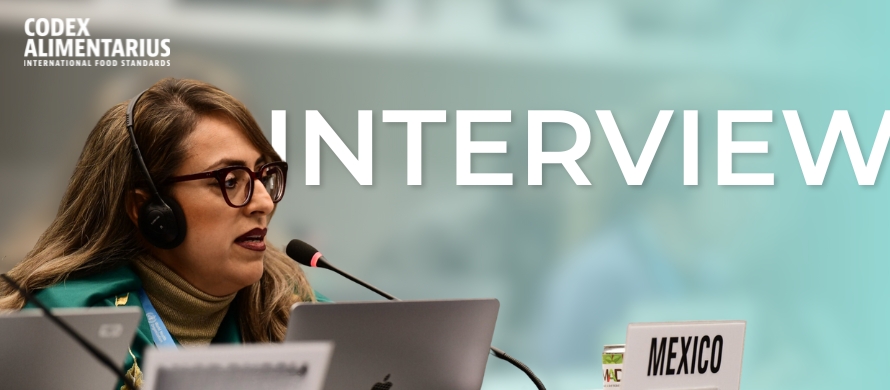
Members and Observers from over 30 countries will meet in Mexico City, Mexico, from 25 February to 1 March 2025 to develop standards at the 23rd session of the Codex Committee on Fresh Fruits and Vegetables (CCFFV). Hosted by Mexico, this year the meeting will be chaired for the first time by Andrea Genoveva Solano Rendón, Head, Unidad de Normatividad, Competitividad y Competencia, Secretaría de Economía, Mexico.
Andrea, thank you for your time. As a first-time Chairperson of CCFFV, what are your primary goals for the 23rd session, and how do you plan to ensure that the Committee continues to address the evolving needs of global trade in fresh fruits and vegetables?
The main goal as Chairperson of CCFFV23 is to ensure that the Committee continues to make progress in drafting standards that contribute to the safety, quality and fairness of the international food trade, and that these standards meet the needs of consumers, producers and, ultimately, countries. Consumers must have confidence in the safety and quality of the food products they buy, and CCFFV plays a key role in creating the standards that oversee these products.
Furthermore, we seek an exchange of ideas between Members and Observers to effectively address the needs of the global market, as well as maintaining, during the workdays, a flexible and dynamic environment through the participation of all Members, ensuring that our regulations are inclusive and adaptable to the diverse realities of countries and regions.
Chairing a Codex committee involves facilitating collaboration among Codex Members and Observers from around the world. What strategies will you use to ensure effective communication and consensus-building during the meeting?
We will promote an environment of openness and mutual respect, in which each Member and Observer feels comfortable in sharing their perspectives and concerns. As Chairperson, I will encourage clear and structured discussions, ensuring that all countries and observers can express their views equitably, in addition to facilitating informal working groups and meetings by region, for which rooms will be made available: these rooms will also provide Members with an occasion to reach consensus on different positions.
Likewise, interpretation tools will be used to facilitate a transparent and efficient exchange of information. Both the Mexico team and I will be attentive to the needs of the participants to resolve possible differences and reach solid agreements. Always with a focus on fostering constructive dialogue, to ensure success in the work of the CCFFV and evolution in the conditions of the global market and agriculture.
What do you see as the biggest challenges in harmonizing standards for fresh fruits and vegetables across diverse agricultural practices and regions?
One of the biggest challenges in harmonizing fresh fruits and vegetable standards across diverse agricultural practices and regions is the diversity in production environments, as this will always vary significantly from one country to another, such as, agricultural practices, climatic conditions and agro-industrial infrastructure and technologies. The above can be very different in each region, which can make it difficult to create universal standards that adapt to all those very specific realities. For example, there are countries that have access to advanced technologies in production and processing, while others depend on more traditional methods. These differences can influence the quality, packaging, and transportation methods of fruits and vegetables, which complicates the standardization of standards in each region.
Another important challenge is the variability in the needs of the global market. Consumers in different parts of the world have different preferences and needs regarding the appearance, moisture content, size or ripeness of the products. This calls for a balance between the standard quality required by international markets and the specific conditions of each producing region.
In addition, it is essential that regulations consider the environmental and socio-economic aspects of each country. The harmonization of standards must be sensitive to local capacities and needs, ensuring that standards do not impose excessive burdens on small or medium-sized producers, or those in countries with fewer resources. Finally, cultural barriers can be a challenge. The translation and interpretation of standards can generate inaccuracies affecting the effective implementation of agreed regulations, so we will ensure that the wording of the documents in each of their translations is in accordance with what was established during the plenary session.
To overcome these challenges, as Chairperson, I am going to promote a collaborative approach, where dialogue is favoured among all Members and Observers, respecting the particularities of each region and seeking solutions that are inclusive and flexible, adapted both to the needs of global trade and local capacities.
Looking to the future, what do you think this Committee - and Codex in general - should address?
First, it would be essential to address technological innovations in the production and processing of fresh fruits and vegetables, for example, vertical agriculture. New technologies can significantly improve food quality and safety, but it is necessary that standards are constantly updated to reflect these innovations. This would include the incorporation of emerging technologies in quality monitoring, traceability and conservation methods.
Secondly, it is crucial that the Committee continues working on adapting standards to the challenges of climate change. As climatic conditions change, agricultural practices are affected, and standards must be flexible enough to adjust to these new scenarios. This could include promoting sustainable agricultural practices and establishing standards that favour resilience to extreme weather events.
Another important aspect is the inclusion of small producers in global standards. Often, international standards can be difficult to meet for smaller producers, especially in countries that do not have the same technological advancement. The Committee should work on creating guidelines that allow the inclusion of these producers, ensuring equity in the implementation of standards and promoting their participation in global trade. And finally, the CCFFV will focus on strengthening international cooperation and the exchange of best practices. Codex could play an even more relevant role in creating platforms to share knowledge among Member Countries, allowing all actors in the agricultural sector to benefit from advances in food safety and product quality.
Any final messages for Codex Members and Observers attending CCFFV23?
Participating in the CCFFV is fundamental to contribute to ensuring food quality and safety at a global level. This Committee has a crucial role in establishing international standards that promote fair and transparent trade in fresh products, protecting both the health of consumers and the competitiveness of producers. Collaborative work in this area allows countries to share experiences, knowledge and best practices, adapting regulations to the needs of the industry and ensuring that fruits and vegetables are produced, transported and marketed in accordance with the highest sanitary and quality standards.
By actively participating in the Committee, not only do you contribute to a more equitable trading system, but you also strengthen consumer confidence in the products they consume. It also facilitates adaptation to market changes and innovation, promoting more sustainable and resilient trade. In short, it is an invaluable opportunity to influence the future of global food safety and the quality of fresh products.
Therefore, I urge each of the Codex Members to follow the CCFFV meetings and to achieve the best agreements in favour of the quality and safety of fresh fruits and vegetables. I hope that this next meeting will be fruitful, and I wish all delegates and Observers the greatest success.
Read more
Related content
Strengthening Grenada's voice in global food standards
by the Codex Contact Point of Grenada On 5 June 2026, the Grenada Bureau of Standards hosted a training session for members of the National Codex Committee and the GDBS team, facilitated by Giuseppe...
.tmb-thb5x4.jpeg?Culture=en&sfvrsn=4561bf2b_1)
ACT / Colombia and the Plurinational State of Bolivia strengthen antimicrobial resistance surveillance
Colombia and the Plurinational State of Bolivia are stepping up efforts to tackle antimicrobial resistance (AMR), one of the world’s most pressing health threats, by strengthening laboratory surveillance...
.tmb-thb5x4.jpeg?Culture=en&sfvrsn=d6cd33d9_1)
ACT / Surveys in Latin America provide key recommendations for increased awareness about foodborne AMR
One of the aims of the Action to support implementation of Codex AMR texts (ACT) project is to raise awareness among stakeholders along the food production chain, about the need for responsible and prudent...
.tmb-thb5x4.jpeg?Culture=en&sfvrsn=8634eb_1)
ACT / Bolivian authorities forge ahead with the introduction of e-prescriptions for veterinary antimicrobials
Great progress was made in the fight against antimicrobial resistance (AMR) in the Plurinational State of Bolivia at the end of January, when officials and professionals met to agree on next steps for...
Simulation of a Codex meeting: the value of practical experience
by the Codex Contact Point of Chile A simulation of a session of the Codex Committee on Cocoa Products and Chocolate (CCCPC) was held on 12 December 2024 at the FAO Regional Office for Latin America and...
“Codex and a Honduran emergency” – New Codex video out now
With the growth in the international trade in food comes the need to be able to prevent, detect and manage foodborne diseases across borders. Foodborne diseases can occur even when there are robust food...
Jamaica expert recounts the benefits of participating in Codex standards setting
When implemented, Codex standards facilitate fair practices in the food trade and protect consumer health. It is therefore expedient for countries to be able to participate in the standards setting processes....
WAAW/ Meet the coordinator of the ACT project in Latin America and the Caribbean region
María de los Angeles Gatica is the regional coordinator for the Action to support implementation of Codex AMR texts (ACT) project, which helps countries contain foodborne antimicrobial resistance (AMR)....
WAAW/ ACT project is helping the Plurinational State of Bolivia tackle the threat of foodborne AMR
The FAO-implemented and Republic of Korea-funded Action to support implementation of Codex AMR texts (ACT) project is being carried out in six countries, of which one is the Plurinational State of Bolivia....